
This is a regular feature for paid subscribers wherein I write a little bit about what I’ve been reading and/or watching.
If you’re not yet a paid subscriber but regularly read, enjoy, or share Unpopular Front, please consider signing up. This newsletter is completely reader-supported and represents my primary source of income. And, at 5 dollars a month, it’s less than most things at Starbucks.
When the Clock Broke is now out in paperback and available wherever books are sold. If you live in the United Kingdom, it’s also available there. The UK edition is also apparently available all over the world, too! I’ve received reports now of book sightings in places as far as Kuala Lumpur, Malaysia, and Christchurch, New Zealand. It seems relatively easy to find in Commonwealth countries and at English-language bookstores abroad.
I also do a film podcast with Jamelle Bouie of The New York Times. On our Patreon, we have a lot of bonus content, including a weekly politics discussion.
I’ll be on the Know Your Enemy podcast discussing some recent pieces. I believe the episode drops tomorrow AM, so keep an eye out.
On Monday, October 26, I will be on a panel for A.J.A Woods’s very fine book The Cultural Marxism Conspiracy. It will be 7:30 to 9 at the Verso Office. The event is free, but limited space means you must RSVP.

The great Marxian economist Anwar Shaikh died last week. Shaikh was a theorist of capitalist competition, and I first encountered his work when trying to better understand the concepts of coercive and “fratricidal competition.” To a non-economist, his observations can sound intuitive and even commonsensical, which is an indication of how deformed that discipline has become. His basic insight is that capitalism is driven by firms’ need to accumulate profits, and competition is defined not by market equilibrium but by a relentless, destructive war of all against all that coerces them to slash costs or adopt labor-saving technology to survive. In our contemporary discussion of AI, his point that technological advance is not optional but rather compulsory because of the relentless struggle between capitals is crucial. What is rational and necessary on the level of one company—keeping abreast of its competitors—can produce systemic outcomes that are undermining to each sector and the economy as a whole.
In Jacobin, Vivek Chibber makes the case for Shaikh as being the most important Marxian economist since Marx himself:
Capitalism: Competition, Conflict, Crises was hailed an instant classic. The accolades were extraordinary, and it is striking how many compared it to Marx’s own great work. James K. Galbraith suggested that there hadn’t been any economic treatise so ambitious and so successful in 150 years (i.e., since Marx himself), Geoffrey Harcourt called it “possibly the most comprehensive structure since Marx’s Capital,” and John Grahl wrote in the New Left Review that “the scope and scale of Capitalism are such as to invite comparison with Marx’s Capital itself.” It was a staggering achievement, and the economics profession instantly realized it.
The publication of Anwar’s magnum opus was a watershed moment in the history of Marxian economics. There have been other works of great importance published in the past twenty-five years or so. But none with the ambition, the thoroughness, the extraordinary erudition, and sheer breadth of Anwar’s book. With it, Marxist political economy can be in conversation with mainstream economics at every level of abstraction and in every domain that the economic theory inhabits. Even though it has been a decade since it was published, its full significance has yet to be absorbed. Anwar spent his last years tirelessly lecturing on different aspects of the argument, trying to make it absorbable. But while a decade is a long time in biographical years, it is but a flicker in intellectual history. It will take some time for the full significance of the work to be appreciated. But then, it is rare for a book to even be worthy of such consideration.
I have tried to read Shaikh’s magnum opus, but although I can understand the basic points, I must admit the book’s specific empirical findings and formal economic arguments are a little beyond me.
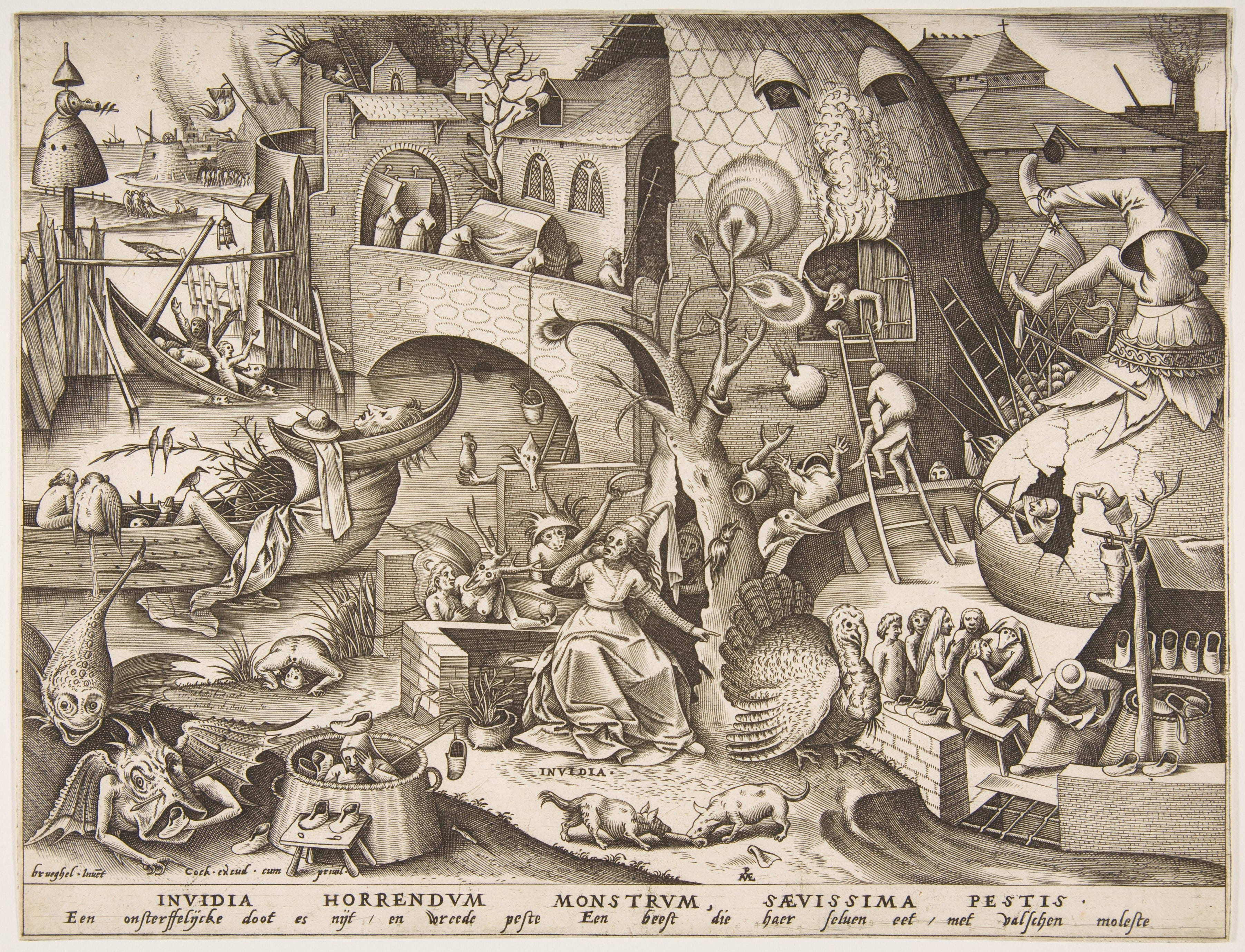
Speaking of destructive acquisitiveness, The Lamp has an issue on the seven deadly sins with a bunch of literary luminaries each taking their own favorite vice. I want to highlight B.D. McClay’s wonderful essay on envy, perhaps the most interesting—and certainly most painful and self-destructive—of the sins. (I always wanted to write a book, a novel maybe, with the title The Cure for Envy. I’m putting this down now to copyright it.)
Envy is often used synonymously with jealousy, but jealousy, in its strict sense, is a simpler feeling. Jealousy has to do with things you have and not wanting to lose them. Envy has to do with things you don’t have and wanting others not to have them, sometimes more than simply wanting them for yourself. A jealous person might be afraid of somebody “stealing” their romantic partner, but an envious person might want that partner for no reason other than that somebody else did first. Jealousy is anxious. Envy is resentful. Jealousy is Othello’s vice. Envy is Iago’s. Jealousy is a nasty vice, but not so hard to overcome, because sadness over the loss of something precious to us is a reasonable feeling. As an intellectual matter, you can decide not to be jealous and, with time, bring your feelings into line with that decision. Envy is subtler; it compromises our judgements and our aspirations, shrinking and distorting our interior world as well as our sense of the world around us. If you’ve ever been in the throes of envy but successfully shaken it off, its perspective looks like insanity. How could you have ever thought about the world that way?
