
This is a regular feature for paid subscribers wherein I write a little bit about what I’ve been reading and/or watching.
If you’re not yet a paid subscriber but regularly read, enjoy, or share Unpopular Front, please consider signing up. This newsletter is completely reader-supported and represents my primary source of income. And, at 5 dollars a month, it’s less than most things at Starbucks.
When the Clock Broke is now out in paperback and available wherever books are sold. If you live in the United Kingdom, it’s also available there. The UK edition is also apparently available all over the world, too! I’ve received reports now of book sightings in places as far as Kuala Lumpur, Malaysia, and Christchurch, New Zealand. It seems relatively easy to find in Commonwealth countries and at English-language bookstores abroad.
I also do a film podcast with Jamelle Bouie of The New York Times. On our Patreon, we have a lot of bonus content, including a weekly politics discussion.
In case you missed it, I announced my new book project this past week.—

I’m really encouraged by the enthusiastic response the idea has garnered already, and have been especially interested in all the offers from former members of LaRouche’s organization to talk. I’m actually a little overwhelmed by the volume of offers at the moment, but I’m starting to get things organized. To that end, I’ve set up a kind of “tip line” for this book: if you have experience with LaRouche’s group, know someone who does, or have interesting information and resources to share in general, please email me at johnganz@proton.me
The messaging app on Substack is annoying, and I avoid it: if you want to reach me about this project, email is much better.
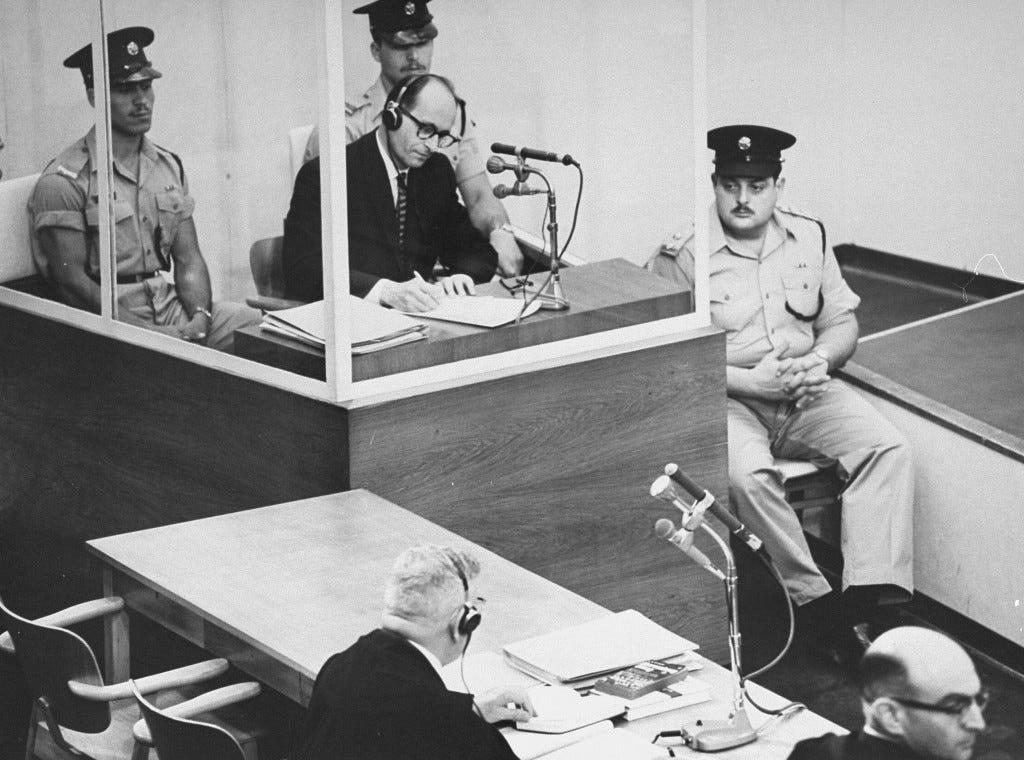
For a recent episode of our podcast, Jamelle and I discussed Margaretha von Trotta’s 2017 film Hannah Arendt, which focuses on Arendt’s coverage for The New Yorker of the trial of Nazi official Adolf Eichmann and the subsequent controversy. (The episode should be up on our Patreon soon.) While preparing for the recording, I read an essay by the great historian Anson Rabinbach, who died last year, called “Eichmann in New York: The New York Intellectuals and the Hannah Arendt Controversy.” Originally published in the journal October in 2004, the piece is an intellectual history of the fallout from Arendt’s series of articles that gave us “the banality of evil.”
Considering the centrality of clichés in Arendt’s diagnosis of Eichmann’s mindless form of evil, it's somewhat ironic that that phrase has become a cliché in its own right. It’s worth revisiting exactly what she meant by it. The banality of evil refers to the kind of thoughtlessness that she thought Eichmann demonstrated in carrying out the Holocaust; He was unable to tell right from wrong, she said, because he had given up his capacity for thought and judgment, specifically his ability to view the world from another’s perspective. As she wrote in the postscript to the book:
Eichmann was not Iago and not Macbeth, and nothing would have been farther from his mind than to determine with Richard III “to prove a villain.” Except for an extraordinary diligence in looking out for his personal advancement, he had no motives at all. And this diligence in itself was in no way criminal; he certainly would never have murdered his superior in order to inherit his post. He merely, to put the matter colloquially, never realized what he wasdoing. It was precisely this lack of imagination which enabled him to sit for months on end facing a German Jew who was conducting the police interrogation, pouring out his heart to the man and explaining again and again how it was that he reached only the rank of lieutenant colonel in the S.S. and that it had not been his fault that he was not promoted. In principle he knew quite well what it was all about, and in his final statement to the court he spoke of the “revaluation of values prescribed by the [Nazi] government.” He was not stupid, It was sheer thoughtlessness—something by no means identical with stupidity—that predisposed him to become one of the greatest criminals of that period. And if this is “banal” and even funny, if with the best will in the world one cannot extract any diabolical or demonic profundity from Eichmann, that is still far from calling it commonplace. It surely cannot be so common that a man facing death, and, moreover, standing beneath the gallows, should be able to think of nothing but what he has heard at funerals all his life, and that these “lofty words” should completely becloud the reality of his own death. That such remoteness from reality and such thoughtlessness can wreak more havoc than all the evil instincts taken together which, perhaps, are inherent in man—that was, in fact, the lesson one could learn in Jerusalem. But it was a lesson, neither an explanation of the phenomenon nor a theory about it.
