
This is a regular feature for paid subscribers wherein I write a little bit about what I’ve been reading and/or watching.
If you’re not yet a paid subscriber but regularly read, enjoy, or share Unpopular Front, please consider signing up. This newsletter is completely reader-supported and represents my primary source of income. And, at 5 dollars a month, it’s less than most things at Starbucks.
When the Clock Broke is now out in paperback and available wherever books are sold. If you live in the United Kingdom, it’s also available there. The UK edition is also apparently available all over the world, too! I’ve received reports now of book sightings in places as far as Kuala Lumpur, Malaysia, and Christchurch, New Zealand. It seems relatively easy to find in Commonwealth countries and at English-language bookstores abroad.
I also do a film podcast with Jamelle Bouie of The New York Times. On our Patreon, we have a lot of bonus content, including a weekly politics discussion.
Reminder: I will be coming to the UK to give a talk at King’s College London on March 26th! See the details and reserve a (free) spot here.
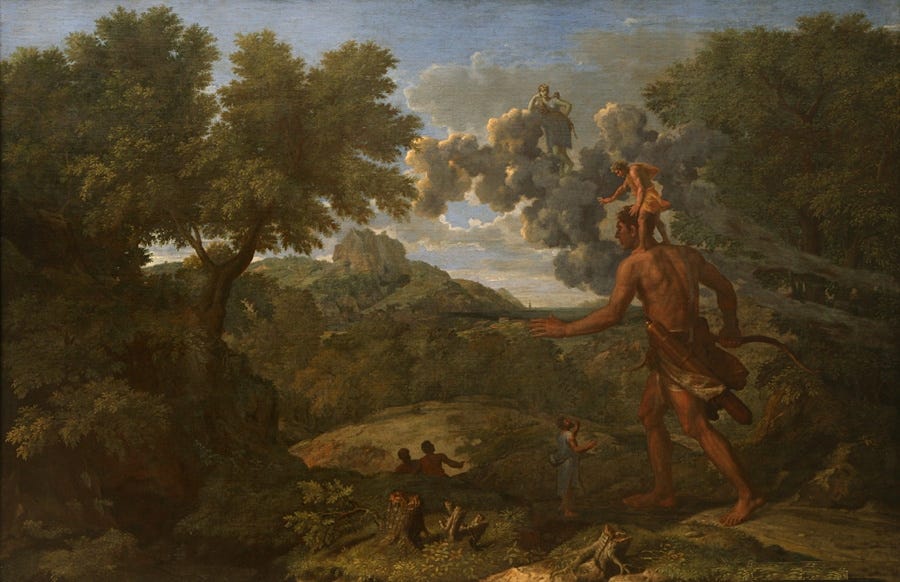
“Orion, the subject of this landscape, was the classical Nimrod; and is called by Homer ‘a hunter of shadows, himself a shade’. He was the son of Neptune; and having lost an eye in some affray between the gods and men, was told that if he would go to meet the rising sun, he would recover his sight. He is represented setting out on his journey, with men on his shoulders to guide him, a bow in his hand, and Diana in the clouds greeting him. He stalks along, a giant upon earth, and reels and falters in his gait, as if just awaked out of sleep, or uncertain of his way; – you see his blindness, though his back is turned. Mists rise around him, and veil the sides of the green forests; earth is dank and fresh with dews, the ‘grey dawn and the Pleiades before him dance, ’ and in the distance are seen the blue hills and sullen ocean. Nothing was ever more finely conceived or done. It breathes the spirit of the morning; its moisture, its repose, its obscurity, waiting the miracle of light to kindle it into smiles: the whole is, like the principal figure in it, ‘a forerunner of the dawn’. The same atmosphere tinges and imbues every object, the same dull light ‘shadowy sets off’ the face of nature: one feeling of vastness, of strangeness, and of primeval forms pervades the painter’s canvas, and we are thrown back upon the first integrity of things.”
—William Hazlitt, “On A Landscape of Nicolas Poussin”
I spoke to Nathan J. Robinson in Current Affairs about When the Clock Broke and the 1990s.
