
How Socialist were the National Socialists? Part 2
The Nazi Economy
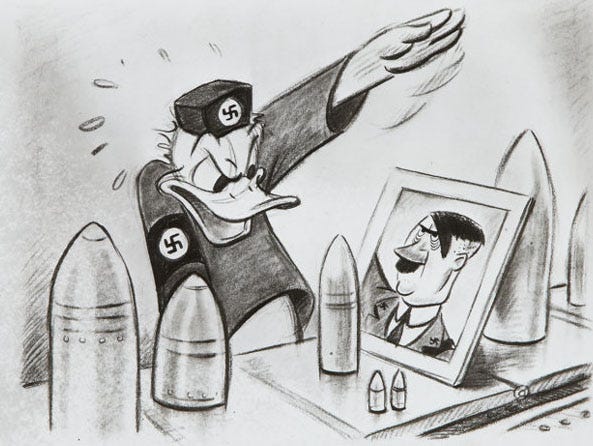
Welcome back to another Unpopular Front article on my favorite topic: the Nazis!
In Part 1, I looked at the theoretical background and rhetoric of Nazi economics. In this part, we will look at what the Nazis actually did to the German economy.
To briefly recap, in Mein Kampf, Hitler made the distinction between financial, parasitic capitalism and productive, creative capitalism that undergirds Nazi economic thought. As many of my very learned readers have pointed out, that diremption comes from an entire tradition of reactionary thought in Europe, which I don’t have time to get into; see my posts on reactionary modernism. The proximate influence on the party’s economic doctrine was the engineer-turned-monetary-crank Gottfried Feder, who retained a romantic, agrarian anti-capitalist outlook from the völkisch tradition, combined with a belief that technological progress and productivity could be liberated from the shackles of bankers. The glue here, as it would be throughout the Nazi system, was antisemitism. The Jew was identified with parasitic capital, the Aryan with creative capital. Big industrialists—as long as they were not Jewish—were okay because they were productive and creative. Private property was not to be menaced; as Feder wrote, “The fundamental recognition of private property is deeply anchored in the clear awareness of the Aryan spiritual structure.”1
Feder did not get the opportunity to put his rather crackpot proposals into practice; he was sidelined under pressure from a camarilla of pro-Nazi business tycoons and the banker and economist Hjalmar Schacht, who redirected Nazi policy away from völkisch romantic populism. My point here should be clear: Nazi ideology, even at its most “socialist,” never fundamentally threatened the institution of private property, and it believed that German capitalists were an expression of Aryan superiority. Then, in practice, the regime had to abandon even its attack on high finance as a concession to economic reality and its bellicose aims.
The Baseline
Nazi economic policy had two intertwined aims: 1) to get out of the Depression, and 2) to rearm the nation to prepare for war against the Soviet Union and the Western democracies. To accomplish this, they’d require an alliance with heavy industry. This close collaboration of the state and the private sector is one of the features that gets labeled “socialism,” and, yes, it was not the laissez-faire, liberal capitalism of the 19th century, but neither was it totally unusual. Across post-World War I Europe, state-industry cooperation was the norm.
The historian Charles Maier, in his classic study Recasting Bourgeois Europe, argued that the years between 1918 and 1925 saw a fundamental shift in how Western European elites managed capitalist economies. The combination of mass democracy, organized labor, demobilization, and inflation had made pure parliamentary liberalism unworkable. The 19th-century model of hurly-burly free-market capitalism was not coming back. What replaced it was a set of arrangements Maier called “corporatist”: ongoing negotiated relationships among organized capital, organized labor, and the state, in which industries were grouped into peak associations, wages and prices were set through collective bargaining or state mediation, and policy was made through bargaining among these blocs rather than purely through parliament, which could be held hostage by an uncooperative interest group.2
The German prototype was the Stinnes-Legien Agreement of November 1918, signed in the chaos of the immediate post-armistice period. Hugo Stinnes, representing heavy industry, and Carl Legien, representing the trade unions, agreed to recognize each other formally as bargaining partners: industrialists would accept the eight-hour day and recognize unions as legitimate; unions would help suppress the more revolutionary currents of the post-war workers’ movement. The two sides created the Zentralarbeitsgemeinschaft, a peak-level joint body for managing labor relations across German industry.3
Similar arrangements that balanced relations between labor, industry, and the state emerged across Europe. According to Maier, fascism differed only in intensity from the paths chosen by the Western democracies. He writes of fascist Italy: “There were alternative paths to stability in the 1920’s. They all involved new fusions of economics and political power: more consistent state interventions in the market, and a greater role in the formulation of public policy entrusted to industry. Italy adopted a harsher path toward this new stability than did France or Germany, but with many of the same results.”4
So the Nazis did not arrive in a pure free-market environment and then impose their self-devised state-directed system. The baseline of European capitalism was already highly corporatist before the Depression. The Nazis’ putative socialism must be measured against the prevailing practices in Europe—and of course, the United States, which would implement both the New Deal and a highly directed wartime economy.
But let’s turn now to the specifically German approach to the Great Depression.
The Plan
Nazi economics minister Hjalmar Schacht was not from the Bohemian and crackpot milieu of the early NSDAP and certainly no socialist; he was an echt example of bourgeois respectability, onetime president of the Reichsbank, doctor of economics from Kiel, co-founder of the left-liberal German Democratic Party in 1918, and the man widely credited with ending the hyperinflation of 1923 through the introduction of the Rentenmark. Out of frustration with the Weimar Republic, he had moved rightward through the late 1920s, broken with the liberal democrats, and by 1932 was openly campaigning for Hitler’s chancellorship. He had concluded that only Hitler could contain the communist threat and deliver the kind of national-conservative authoritarian government he favored. He was, in other words, exactly the kind of respectable establishment figure whose support gave the Nazi seizure of power its veneer of continuity with the old German Right. When Hitler appointed him Reichsbank president in March 1933 and Minister of Economics in 1934, the message to German industry and to foreign creditors was clear: the wild men of the SA and the cranks of the Feder school would not be running the economy. The grown-ups were in charge.5
Schacht’s toolkit was conventional by the standards of 1930s emergency economics, just applied with more aggression and fewer scruples than his peers elsewhere. The first instrument was deficit-financed public works: the famous Autobahnen, of course, but also drainage projects, public housing, river works, and a vast expansion of the Reichsarbeitsdienst that put unemployed young men into uniformed work brigades. This was Keynesianism before Keynes had finished writing the General Theory, and it was not original to the Nazis: the Nazis inherited a public works program from the previous Schleicher government, and Roosevelt was doing comparable things across the Atlantic.6
The second instrument, and this is where Schacht’s particular cleverness came in, was the financing of rearmament through what amounted to a giant accounting trick. He created a shell company called the Metallurgische Forschungsgesellschaft, or Mefo, which existed for no purpose other than to issue bills of exchange to armaments manufacturers. The manufacturers would deliver weapons to the Wehrmacht and receive Mefo bills in payment; the Mefo bills were guaranteed by the Reichsbank and could be discounted at commercial banks. This kept the true scale of military spending off the official government books—important, since the Treaty of Versailles still nominally restricted German rearmament—and allowed the regime to pump enormous sums into the armaments industry without showing the deficit on the budget.7 By 1938, Mefo bills outstanding totaled around 12 billion Reichsmarks, a substantial fraction of GDP. It was a fiscal time bomb that Schacht assumed would eventually have to be defused, but the regime never defused it; it just kept rolling it forward.
The third instrument was the New Plan of September 1934, Schacht’s reorganization of foreign trade. Germany was chronically short of foreign exchange because rearmament required massive imports of raw materials— iron ore, copper, rubber, oil—and the country had limited exports to pay for them. Schacht’s solution was bilateral trade agreements, mostly with countries in Southeastern Europe and Latin America, in which Germany would buy raw materials in exchange for German-manufactured goods through state-managed clearing arrangements. This effectively created a German-led trade bloc that bypassed the international gold-standard system and allowed Germany to acquire strategic materials without spending hard currency.8 It also gave Berlin enormous economic leverage over its trading partners, which would matter politically as the decade progressed.
None of this—deficit spending, off-balance-sheet financing, bilateral trade controls—is socialism. Public works, exchange controls, and creative central-bank financing were the standard responses to the Depression across the developed world in the mid-1930s. Roosevelt was doing public works. Britain had abandoned the gold standard. France had imposed exchange controls. The Schachtian recovery was a more aggressive variant of policies you could find, in milder form, almost everywhere. What it was was state-directed capitalism in the corporatist mode we just looked at: the German variant of a pan-European phenomenon, run by a conservative banker.
The Labor Front
What was markedly different was the regime’s treatment of labor. In May 1933, less than four months after Hitler became chancellor, the regime moved against the trade unions. On May 2—the day after the regime had cynically celebrated the first ever official “Day of National Labor” on May 1—SA and SS units occupied union offices across Germany, arrested union leaders, and seized union assets. The independent trade union movement, which had been one of the largest and best-organized in Europe, was destroyed in a single coordinated operation.9 In its place, the regime created the Deutsche Arbeitsfront (DAF), the German Labor Front, headed by a drunk, Robert Ley. The DAF was not a union. It was a mass organization that incorporated workers and employers together under party control, with the explicit purpose of preventing class conflict by eliminating the possibility of independent worker action. Strikes were prohibited. Collective bargaining was abolished. Wage rates were set by state-appointed Treuhänder der Arbeit (Trustees of Labor) on a regional basis.10
Interwar corporatism was tripartite: capital, labor, and state in a negotiated relationship, with each side retaining independent organization and bargaining power. The Nazi reorganization of 1933 eliminated one of those three legs. Workers continued to exist, of course, and they continued to be paid wages, but they no longer had any independent institutional voice. The DAF was a transmission belt running from the state to the workforce, not a partner in any meaningful sense.
What this meant in practice was that the recovery was real, but its benefits were unevenly distributed. Real wages stagnated and in some sectors fell through the 1930s; profits rose substantially.11 Workers got full employment and the Kraft durch Freude leisure programs—subsidized vacations, cultural events, the Volkswagen savings scheme that delivered no actual cars—but they did not get rising real incomes, and they had no mechanism to demand them. Capital got a state that built infrastructure, financed armaments orders, suppressed labor costs, and asked relatively little in return except cooperation with rearmament. If socialism is defined as workers’ control over the means of production, this was certainly not socialism. It was, from the perspective of German heavy industry, an extremely good deal.
Privatization
One of the big myths of the “Nazis were socialists” crowd is that the Nazis substantially nationalized and took direct ownership of German industry. In fact, the opposite is the case: the early Nazi regime saw a wave of privatization. As hinted by the title of Germà Bel’s Economic History Review paper, “Against the Mainstream: Nazi Privatization in 1930s Germany,” this was not the prevailing trend in Europe, where nationalization was the norm.
The starting point is Weimar Germany in 1932, which had a much larger state-owned sector than is usually remembered. The Brüning government, scrambling to contain the banking crisis of 1931, had taken majority or substantial minority stakes in the four largest commercial banks — Dresdner, Commerzbank, Deutsche Bank, and the Berliner Handels-Gesellschaft — when those banks would otherwise have collapsed. The state had also acquired control of Vereinigte Stahlwerke (United Steelworks), Germany’s largest steel producer, through a similar emergency intervention. Various shipping firms, including parts of Hamburg-South America Line, had been rescued and brought into state ownership. The Reichsbahn (railways) and Reichspost had been state-owned for decades. Add in municipal utilities, mining concerns, and various Weimar-era holdings, and by 1932 the German state owned or substantially controlled a meaningful chunk of the commanding heights of the economy.12
Between 1934 and 1937, the Nazi regime systematically returned most of this to private hands. Vereinigte Stahlwerke was re-privatized starting in 1934, with major shares going to the Friedrich Flick group. The four large commercial banks were re-privatized between 1936 and 1937, with the state divesting the stakes it had acquired in the 1931 crisis. Several shipping firms were returned to private ownership. Various municipal utilities—electricity, water, transport—were returned to private operation where the regime favored that solution. Bel, who has done the most thorough work on this, argues that the Nazi case represents the first systematic large-scale privatization in modern history, predating Thatcher by half a century. It was deliberate ideological policy, not merely opportunistic asset sales: the regime believed, on principle, that private ownership directed by the state was preferable to direct state ownership.13
Why? Partly because Nazi ideology, despite the “socialist” branding, was genuinely committed to private property as an Aryan virtue, as we saw in Part 1 with Feder’s writings. Partly because the regime needed the active cooperation of German industrialists for rearmament, and that cooperation came more reliably from owners with stakes in the outcome than from civil servants with no skin in the game. And partly because the regime’s leadership —Schacht especially, but also Hitler in his more pragmatic moods—understood that markets allocate capital and manage operations more effectively than ministries do, even when the ultimate direction of the economy is set politically.
The numbers tell the story bluntly. By the late 1930s, after the privatizations were complete, somewhere between 75 and 85 percent of German industrial output came from privately owned firms. The state’s direct ownership share—railways, post, the new Reichswerke Hermann Göring conglomerate, various utilities—was around 15 to 20 percent of industry. This was comparable to contemporary Britain and lower than what postwar West Germany would maintain under Adenauer. To put it as plainly as possible: Nazi Germany at its most “socialist” had a smaller state-owned sector than Christian Democratic West Germany in the 1950s or Fourth Republic France, where the state owned over a quarter of productive capital.14 The Soviet Union, the actually-socialist comparison case, had 100 percent state ownership of large-scale industry by the late 1930s.
It is sometimes asserted that because of the state interventions in the economy, private property. In Nazi Germany was only nominal, but this was not the reality. As Buchheim and Scherner write in their paper “The Role of Private Property in the Nazi Economy: The Case of Industry,” firms retained a great deal of autonomy even under the rearmament drive and in wartime, and freedom of contract was generally respected.15
There were two important counter-currents to the privatization story, and fairness requires noting both.
The first was Reichswerke Hermann Göring, founded in 1937. This was a new state-owned industrial conglomerate built around lower-grade German iron ore that private steelmakers had refused to develop because it wasn’t economical. The regime created Reichswerke to do what the market wouldn’t — to bring strategic raw materials into production for autarky and rearmament purposes, regardless of cost. By 1939, it was already large; by the wartime peak, it had absorbed enormous quantities of plundered industrial capacity from occupied Europe and become arguably the largest industrial enterprise on the continent, with something approaching 600,000 employees. But notice the structure: Reichswerke was created to supplement private industry, not to replace it. The bulk of German steel production stayed in private hands throughout the regime’s existence.16
The second was the Volkswagenwerk, founded in 1937 as a subsidiary of the Deutsche Arbeitsfront. Technically party-owned rather than state-owned, it operated under direct state and party control. It was financed in significant part by forced savings extracted from German workers who paid into the Volkswagen-Sparkarte scheme and never received the cars they were promised — a kind of compulsory regressive taxation dressed up as consumer purchase. Volkswagen is genuinely difficult to classify in conventional public-private terms. It was the regime’s own creation, organized through party rather than state structures, financed through coerced savings of workers. It looks more like a fascist innovation than either capitalism or socialism.17
There’s also a definitional complication worth noting. The regime’s notorious institutional chaos—described in Franz Neumann’s magnum opus Behemoth: The Structure and Practice of National Socialism—meant overlapping jurisdictions of state ministries, party organs, SS economic enterprises, and personal fiefs of figures like Göring and Himmler, which makes the public-private distinction blurrier in some cases than the formal ownership figures suggest. Was the SS empire of construction firms, quarries, and industrial enterprises — which by the war’s end employed hundreds of thousands of slave laborers — a “state” enterprise? A “party” enterprise? A “private” enterprise of Himmler’s? It was genuinely all three at once, in ways that don’t map onto modern categories.18
But none of this changes the basic picture. Throughout the Nazi period, the majority of German industrial production occurred in privately owned firms, that majority was highest around 1937–1938 after the privatizations were complete, and even at the regime’s wartime peak—when state and party-owned enterprises had grown substantially through Reichswerke expansion and seizure of foreign assets—private firms still accounted for the bulk of industrial output, including most war production.19
The regime did not abolish capitalism. It deliberately preserved capitalism, and in some respects expanded the share of the economy held in private hands compared to what it had inherited from Weimar. What it did instead was reshape the political relationships around capitalism: destroying organized labor, subordinating capital to state direction on questions of investment and output, and bending the entire structure toward rearmament and eventual war.
The Pay Off
So what was Nazi political economy? Not socialism, plainly. The regime preserved private property, returned state holdings to private hands, and ran a smaller public sector than postwar Christian Democratic West Germany. Not laissez-faire capitalism either: Schacht’s apparatus directed credit, controlled foreign exchange, set wages by administrative fiat, and steered investment toward armaments at scales no liberal government would have countenanced. What it was was the corporatist political economy of interwar Europe with one of its three legs hacked off.
This is the point at which a certain kind of reader, usually but not always on the libertarian right, will object: but didn’t Roosevelt do the same thing? Didn’t the New Deal involve massive state direction of the economy? Wasn’t the American war economy of 1942–45 even more “directed” than Hitler’s, with price controls, raw material allocation, wage controls, and the federal government owning something like 40 percent of manufacturing capital by 1945? And the answer is: yes, in raw quantitative terms, much of that is true. By the metric of “how much of the economy was the state allocating?”, the wartime United States matched and in some respects exceeded Nazi Germany.20 The first New Deal’s National Recovery Administration, struck down by the Supreme Court in 1935, was explicitly modeled in part on European corporatism, and its director Hugh Johnson openly admired Mussolini.21 The structural similarities are real, and pretending otherwise would be silly.
The decisive feature of Nazi political economy was not the quantity of state direction; it was the elimination of independent labor and constitutional politics from the corporatist structure. The New Deal moved in exactly the opposite direction on the labor question. The Wagner Act of 1935 federally protected the right to organize, strike, and bargain collectively. Union membership tripled between 1933 and 1940. The American state intervened to empower labor as an independent political force; the Nazi state intervened to destroy it as one. There was a comparable degree of state involvement in the economy, but an opposite vector with respect to labor relations.22
The American wartime economy makes the same point even more sharply. Yes, federal spending hit 40-plus percent of GDP. Yes, the War Production Board allocated raw materials, and the Office of Price Administration imposed comprehensive rationing. Yes, the federal government owned a vast share of manufacturing plant by 1945. But the War Labor Board included union representation. Strikes occurred during the war–major ones, in coal and steel, which Roosevelt could not crush by sending in the SS. Constitutional government persisted. A free press criticized FDR vigorously throughout. There was a competitive election in 1944, in which the incumbent could in principle have lost. The American war economy used some of the same instruments as the Nazi war economy and operated within a fundamentally different political structure.23
This is what is missed when people reach for “fascist economics” as a synonym for state intervention, or “socialism” as a synonym for any limit on capital. The Nazi case was distinctive not because the regime did unusual things to the economy but because of what it had already done to the political sphere before it touched the economy. By the time Schacht was writing Mefo bills and Göring was running the Four-Year Plan, the unions were destroyed, the parties banned, the press muzzled, and the courts gleichgeschaltet. The economic policy was being implemented inside a political vacuum that no democratic state, however interventionist, has ever produced — and inside which the eventual descent into autarky, plunder, and slave labor became not just possible but, given the regime’s animating purposes, almost inevitable.
For the descent—the radicalization after 1936, the wartime exploitation of occupied Europe, the moral abyss of IG Farben at Auschwitz-Monowitz—you can read Adam Tooze’s The Wages of Destruction. The short version is that the regime drove its bipartite-corporatist machine straight into a war it could not win, and the structure that had looked so impressive in 1938 turned out, by 1945, to have been a mechanism for converting Germany and Europe into ashes.
Jeffrey Herf, Reactionary Modernism: Technology, Culture, and Politics in Weimar and the Third Reich (Cambridge: Cambridge University Press, 1984). 190
Charles S. Maier, Recasting Bourgeois Europe: Stabilization in France, Germany, and Italy in the Decade after World War I (Princeton: Princeton University Press, 1975).
On the Stinnes-Legien Agreement, see Maier, Recasting Bourgeois Europe, 58–67, and Gerald D. Feldman, The Great Disorder: Politics, Economics, and Society in the German Inflation, 1914–1924 (New York: Oxford University Press, 1993), 99–130.
Maier, Recasting Bourgeois Europe, 545-546.
On Schacht's biography and pre-1933 career, see Christopher Kopper, Hjalmar Schacht: Aufstieg und Fall von Hitlers mächtigstem Bankier (Munich: Hanser, 2006). For an English-language treatment, see John Weitz, Hitler's Banker: Hjalmar Horace Greeley Schacht (Boston: Little, Brown, 1997). Schacht's own self-justifying memoir, Confessions of "The Old Wizard": Autobiography of Hjalmar Horace Greeley Schacht, trans. Diana Pyke (Boston: Houghton Mifflin, 1956), is useful as a primary source for his self-presentation but should be read with appropriate skepticism.
Adam Tooze, The Wages of Destruction: The Making and Breaking of the Nazi Economy (London: Allen Lane, 2006), 38–66. On the continuity with Brüning- and Schleicher-era plans, see Harold James, The German Slump: Politics and Economics 1924–1936 (Oxford: Clarendon, 1986), 343–418
On Mefo bills, see Tooze, Wages of Destruction, 50–55, and Richard Overy, War and Economy in the Third Reich (Oxford: Clarendon, 1994), 195–202.
On the New Plan, see Tooze, Wages of Destruction, 71–96, and Larry Neal, "The Economics and Finance of Bilateral Clearing Agreements: Germany, 1934–8," Economic History Review 32, no. 3 (1979): 391–404.
On the destruction of the unions, see Richard J. Evans, The Third Reich in Power (New York: Penguin, 2005), 458–467, and Timothy Mason, Social Policy in the Third Reich: The Working Class and the National Community, trans. John Broadwin (Providence: Berg, 1993), 77–116
On the DAF and the Treuhänder der Arbeit system, see Mason, Social Policy in the Third Reich, 117–157
On wages and profits, see Tooze, Wages of Destruction, 138–165. The figures are contested in detail, but the broad pattern — tagnant or falling real wages with rising profits—is robust across the major studies.
On the Weimar-era state acquisitions during the 1931 banking crisis and the broader Depression-era expansion of state ownership, see Harold James, The German Slump, 283–342.
Germà Bel, "Against the Mainstream: Nazi Privatization in 1930s Germany," Economic History Review 63, no. 1 (2010): 34–55.
Christoph Buchheim and Jonas Scherner, "The Role of Private Property in the Nazi Economy: The Case of Industry," Journal of Economic History 66, no. 2 (2006): 390–416, for the public/private share estimates. See also the broader discussion in Tooze, Wages of Destruction, 99–134
Buchheim and Scherner, “The Role of Private Property,” 394-395
On Reichswerke Hermann Göring, see Overy, War and Economy, 144–174, and Tooze, Wages of Destruction, 230–242.
On Volkswagen and the Volkswagen-Sparkarte scheme, see Hans Mommsen and Manfred Grieger, Das Volkswagenwerk und seine Arbeiter im Dritten Reich (Düsseldorf: Econ, 1996)
Franz Neumann, Behemoth: The Structure and Practice of National Socialism, 1933–1944 (New York: Oxford University Press, 1944; reissued Chicago: Ivan R. Dee, 2009). On the SS economic empire specifically, see Michael Thad Allen, The Business of Genocide: The SS, Slave Labor, and the Concentration Camps (Chapel Hill: University of North Carolina Press, 2002)
Buchheim and Scherner, "Role of Private Property," 390–416, and Tooze, Wages of Destruction, 552–610, on the war-economy structure.
Mark R. Wilson, Destructive Creation: American Business and the Winning of World War II (Philadelphia: University of Pennsylvania Press, 2016), and Hugh Rockoff, "The United States: From Ploughshares to Swords," in Mark Harrison, ed., The Economics of World War II: Six Great Powers in International Comparison (Cambridge: Cambridge University Press, 1998), 81–121
On the NRA’s corporatist debts and Hugh Johnson’s admiration for Mussolini, see Wolfgang Schivelbusch, Three New Deals: Reflections on Roosevelt’s America, Mussolini’s Italy, and Hitler’s Germany, 1933–1939 (New York: Metropolitan, 2006), and Ira Katznelson, Fear Itself: The New Deal and the Origins of Our Time (New York: Liveright, 2013), 156–194
On the Wagner Act and the New Deal's transformation of American labor, see Nelson Lichtenstein, State of the Union: A Century of American Labor, rev. ed. (Princeton: Princeton University Press, 2013), 20–53.
On the tripartite character of the American war economy, see James B. Atleson, Labor and the Wartime State: Labor Relations and Law during World War II (Urbana: University of Illinois Press, 1998), and Wilson, Destructive Creation, especially chapters 4–6.
On economic front how can we really distinguish between Nazi economy v. Authoritarian capitalism of the modern China & pre-democratic South Korea/Taiwan? Perhaps that Nazi Germany’s distinctive lack of any constitutional order & structural lawlessness allows more executive free reign than modern CCP, which Xi still had to operate under some party-legal structure; maybe South American junta are more akin then in their shared lack of constitutional order?
John, thank you so much for this. I was not aware Substack supported endnotes! I have two bookshelves full of books on the Shoah, over half of which I’ve read, and some I have not such as the Adam Tooze book Wages of Destruction you discuss. And not Maier, but I have read Mayer’s Why Did the Heavens Not Darken? The "Final Solution in History, which—by documenting how Hitler almost always ranted against the Judeo-Bolsheviks.
From my reading, most relevant to your piece is I think Gotz Aly’s Hitler’s Beneficiaries: Plunder, Racial War, and the Nazi Welfare State (2006 [2005 in German]. Apparently, Tooze was critical of Aly in a published review (Adam Tooze, "Economics, Ideology and Cohesion in the Third Reich: A Critique of Goetz Aly's Hitlers Volksstaat," Dapim: Studies on the Shoah 20 (2006): 217–232.) which he has on his website: https://adamtooze.com/wp-content/uploads/2017/01/Tooze-Review-of-Aly-for-Dapim-2005-.pdf
He saw Aly’s work as problematic, first saying: “In Hitlers Volksstaat Aly concerns himself not with Himmler’s expansive schemes of population displacement and genocide, but with the machinery of financial expropriation that stripped the Jewish population of Europe of its wealth.” He admits, “The German population as a whole benefited from these exactions. But it did so indirectly, as contributions taken from the victims of the regime reduced the tax burden that had to be levied on the Reich.”
He goes on, and if you are wondering how this is problematic, so am I: “The devil, according to Aly, is in the detail. The regime of exploitation directed first against the Jews and then the rest of the population of occupied Europe was designed to support a generous system of social provision for the German population. And this in turn was essential to sustaining the mass loyalty that underpinned Hitler’s regime.
The accumulation of small benefits - the marginal reduction in taxes on certain groups in the population, the extension of welfare benefits most notably for the wives of conscripted soldiers, the personal and collective profits of Aryanization and the continental operation of the black market - were not. accidental features of the Nazi regime. They were, Aly claims, the real foundation of consent and cooperation in the Third Reich. They were, in fact, the foundation of a new popular social order in Germany that has lasted to this very day.”
Not being an historian of the holocaust (I’m an historical sociological of the system of real property), I now see that the concern was the Aly’s details were valuable, but the conclusions were over-interpreted, similar to criticisms—which I shared—of Goldhagen’s Hitler’s Willing Beneficiaries. In that case, Mayer’s work seemed much more convincing.
Tooze’s concern was: “It is a measure of the unsettling originality of his work that, whereas it is possible to think of a variety of authors who subscribe to each of the other three positions, Aly may be the first to stake out the territory in the top right hand corner, combining a materialist approach with an emphasis on popular, rather than elite, support for the regime.” In other words, Goldhagen’s approach was idealistic and focused on popular forces rather than elite interest/actions, and the critique of Aly is it is focused on the material interests of the population versus that of the elites.
I found Aly’s work convincing, in that it seemed to show a direct relationship between when the German state was short on funds and when it implemented specific components of the entire extermination/expropriation process of the Shoah. (See Chapter Ten, the Trail of Gold.)
In any case, I’ll have to read Tooze. There goes my summer vacation, when I’m going to be working in any case!