
This is a regular feature for paid subscribers wherein I write a little bit about what I’ve been reading and/or watching.
If you’re not yet a paid subscriber but regularly read, enjoy, or share Unpopular Front, please consider signing up. This newsletter is completely reader-supported and represents my primary source of income. And, at 5 dollars a month, it’s less than most things at Starbucks.
When the Clock Broke is now out in paperback and available wherever books are sold. If you live in the United Kingdom, it’s also available there. The UK edition is also apparently available all over the world, too! I’ve received reports now of book sightings in places as far as Kuala Lumpur, Malaysia, and Christchurch, New Zealand. It seems relatively easy to find in Commonwealth countries and at English-language bookstores abroad.
I also do a film podcast with Jamelle Bouie of The New York Times. On our Patreon, we have a lot of bonus content, including a weekly politics discussion.
I appeared this week on Mike Pesca’s Not Even Mad podcast to discuss the Iran war, libertarianism, and what generally annoys me, with Reason magazine’s Nick Gillespie.
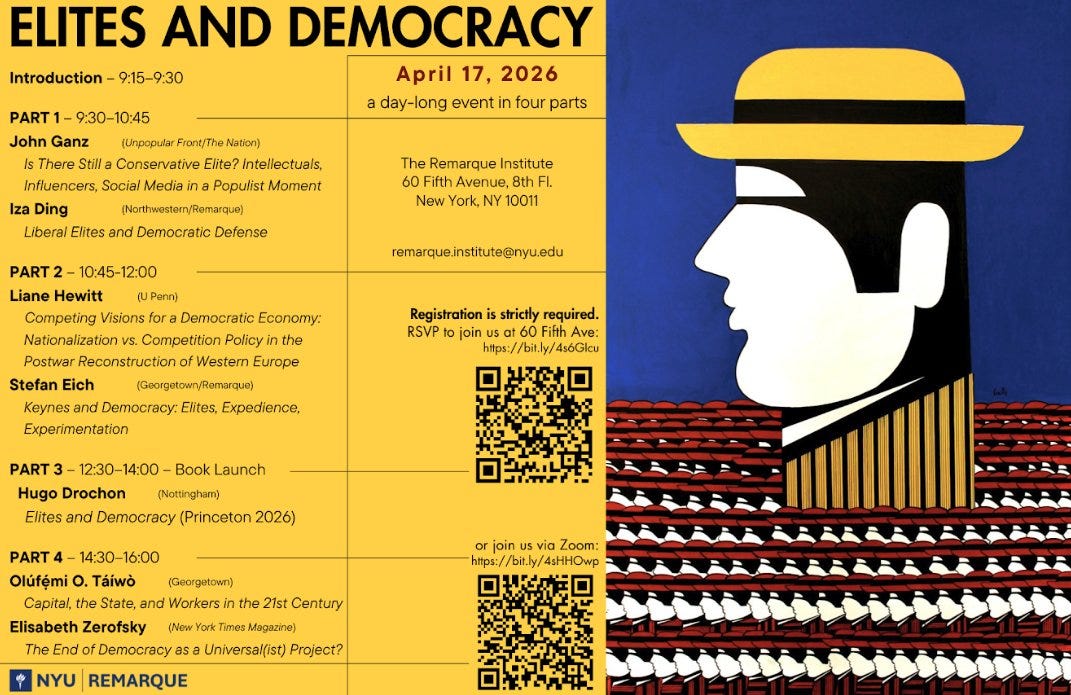
On Friday, April 17th, I will be giving a presentation as part of the day-long “Elites and Democracy” event at NYU’s Remarque Institute. You can register online to attend or tune in on Zoom.
After finishing his latest book, my friend and mentor Rick Perlstein, author of Nixonland, Before the Storm, and Reaganland, has kicked off a Substack called “Rickipedia.” It’s aptly named because, besides being an enormously entertaining writer, Rick is an absolute treasure trove of information about the right and American history more generally.
Hungarians are heading to the polls today to decide whether or not to end the 16-year reign of the Fidesz Party and its leader, Viktor Orbán, who has brought his country back towards despotism. All civilized people in the world hope ardently for this fleshy tyrant’s defeat: perhaps it will signal the breaking of the right-wing wave. At the very least, it will be a stinging rebuke for fascist wannabes worldwide who have looked to his regime for inspiration. In the New Statesman, Ábel Bede:
Yet Orbán’s campaign focus on geopolitics exposes a vulnerability. Hungary’s economy has stagnated in recent years, with investment falling and headline inflation peaking at around 25 per cent in early 2023. The European Union is withholding roughly €17 billion (£14.8 billion) in funds over rule-of-law concerns – resources that previously underpinned rising living standards. As economic pressures mount, voters appear increasingly focused on domestic conditions rather than international positioning.
This shift is fuelling the rise of Orbán’s challenger, Péter Magyar. On the same day as Vance’s visit, Magyar held seven rallies outside Budapest, drawing large crowds even in small towns. His party, Tisza, now leads in several independent polls, with some suggesting it could even approach a constitutional majority. A former Fidesz insider, Magyar rose rapidly after a 2024 scandal that forced the resignation of President Katalin Novák. Since then, he has consolidated support across the political spectrum, positioning himself not as a liberal reformer but as a pragmatic critic of state decline. His campaign avoids abstract debates about democracy, instead focusing on healthcare, education, infrastructure, and corruption. At rallies, that message appears to resonate strongly. In Dévaványa, a town of 7,000, Magyar filled the main square on a weekday afternoon – an unprecedented turnout for an opposition figure in recent years. Asked why voters are responding differently this time, a local organiser offered a blunt explanation: “Because they are much poorer now.”
Magyar’s speeches frequently draw sharp contrasts between everyday hardship and elite wealth. “In ten years, Lőrinc Mészáros… has become richer than the British monarchy did in 400 years,” he told one crowd – a claim that overstates the comparison, though Mészáros’s wealth has indeed surged dramatically. He couples such rhetoric with vivid, emotional appeals, highlighting failing infrastructure and poverty.
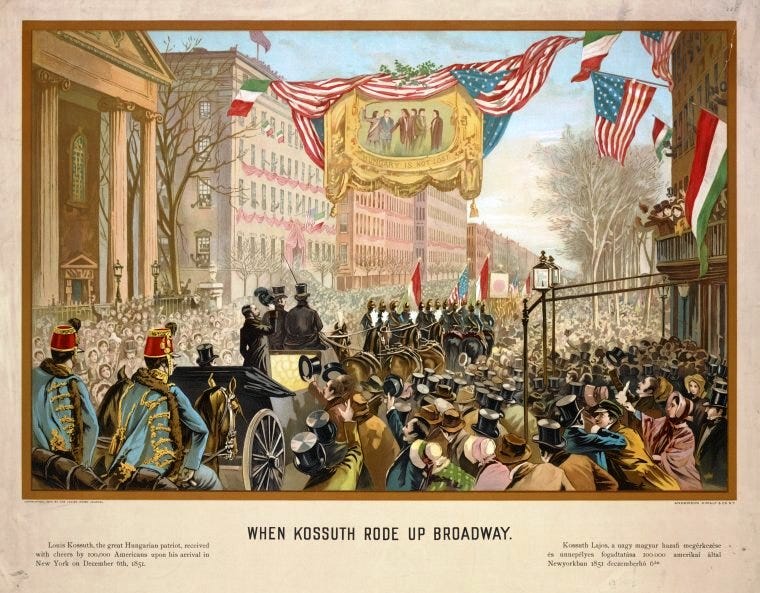
It is not the first time The Democracy, as they used to call the cause writ large, has looked to Hungary for inspiration. I’m reminded of the hero’s welcome Lajos Kossuth received in the United States in the 1850s. He was thronged by adoring crowds, and the country briefly fell under a mania for all things Hungarian. Abraham Lincoln joined other leading citizens of Springfield, Illinois, to call a meeting in honor of Kossuth, and they issued a resolution in support of Hungary’s revolution. Some sources say they met; there’s not much hard evidence for that, but perhaps in the Gettysburg address, there’s an echo of a line in Kossuth’s 1852 speech in Columbus, Ohio—“The spirit of our age is Democracy. All for the people, and all by the people. Nothing about the people without the people – That is Democracy!”
Kossuth wanted to drum up support against the Russians, who had crushed the nascent Hungarian bid for independence, but although Americans had a great deal of affection for the dashing and romantic revolutionary, the political appetite for intervention was not there. Even that great enthusiast Walt Whitman was unswayed, and his remarks later perhaps reflect the country’s mood in a more sober state:
I knew Kossuth—talked with him on several occasions. He still lives, as bright intellectually—the same fine noble soul as ever. When I saw him he was a small man, eloquent to a great height—vivacious. Kossuth made a great mistake after his coming here. He had been almost importuned to come here by officials, by Congress, was brought in an American man-of-war. At that time any one of the nations—Germany, Austria, France, Russia—would have killed him—hung him—if they could have got him in their hands. But Kossuth’s great mistake after he got here was to make an effort to have America range herself in his cause. We all recognized it at once as deplorable. We could not have done it then, could not do it now, ought never to do it. Yet he went up and down through our states, pleading for it. I am even opposed to Congress petitioning the Czar to investigate Siberia—even that is out of our province. We can never be in a position to arbitrate—enforce our arbitrament—in European contests.
Karl Marx and Friedrich Engels went from great admirers of Kossuth’s “bourgeois revolution” against the reactionary powers of old Europe to bitter critics of what they considered to be his toadying to Napoleon III.
I have to take a small issue with an otherwise very fine piece in the New Yorker by Antonia Hitchens about the groyperfication of the GOP—and which also very generously quotes my book:
Fuentes picked up the mantle, repackaging paleoconservatism for the streaming era. In 2022, he put on a political conference in Florida, where he hosted Peter Brimelow, a paleocon who had pitched an early version of the great-replacement theory. (Brimelow has called immigration to the West “Hitler’s revenge.”) In the nineties, William F. Buckley had tried to keep paleocons like Brimelow and Buchanan out of mainstream conservatism by banning such ideas from the pages of National Review. Fuentes helped make their concerns a mass online phenomenon.
