I Built a Robot
Introducing ‘Polybius‘
As the author of a newsletter committed to militant humanism, I’ve sworn never to reproduce charts and graphs. I’ve broken this rule once or twice, but I’ve polemicized on occasion against polling (not polling tout court, just the thoughtless overreliance on it in generating political strategy.) In general, I try to keep W.H. Auden’s commandment from “Under Which Lyre:”
Thou shalt not sit
With statisticians nor commit
A social science
Well, dear readers, I must confess that I’ve committed a social science.
For the past few weeks, I’ve been developing a tool by “vibecoding,” that is, using Claude AI to code for me, which would measure the degree of authoritarian consolidation in the US. It would generate a number—1 out of 100—called the Authoritarian Consolidation Index. If the number is high, that’s bad: it shows a fully or almost fully consolidated regime. If the number is low, it’s good: it shows a healthy, functioning liberal democracy. If you enter Russia, Turkey, or Hungary into the tool, you get scores in the 90s, 80s, or 70s; if you enter, say, Norway or Denmark, you’ll get scores in single digits. Then it gives a summary of what the score means.
How does it generate a number, you ask? Well, it searches the news, reports, and polling, and analyzes them according to several factors:
1. Judicial Independence
2. Federalism/Regional Resistance
3. Political Competition
4. Media Capture
5. Civil Society
6. Public Opinion
7. Mobilizational Balance
8. State Capacity
9. Corporate Compliance
10. Election Interference
Some of these are fairly self-explanatory, but others are not. For instance, “Mobilizational Balance” tries to measure the relative ability of the regime and the opposition to mobilize people for their political projects. It is related to, but distinct from “Civil Society,” which mostly looks at the density of organizations that are separate from the state, and the legal ease of forming and belonging to them. “State Capacity” measures the coercive control the government can actually employ, in part by assessing the size of the security apparatus and its loyalty to the regime, and in part by the bureaucratic expertise it can bring to bear on a problem. “Corporate Compliance” assesses if business elites are bowing down to or resisting the regime. These factors are represented in the output as democratic vital signs. Here’s what they look like from today’s run:
It takes the live search data using Anthropic’s API and then runs it through 11 theoretical models taken from political science and historiography that weigh the factors differently. For instance, the “Tocquevillean” model thinks civil society's robustness is very important, but the “Marxian” model looks at capital and labor relations. A lot of people have said that 11 is too many models. They are probably right, but I got carried away. They are still mostly only different weights. I’m working to make them generate very different interpretations of the same facts. Here’s a sample of how the models look this morning:
The machine also looks at historical data gathered from V-Dem (Varieties of Democracy), the Polity Project, and Freedom House to come up with the best historical analogies.
There’s also a section called “social signals,” which looks at what’s going on right now in the media and politics to figure out the state of play. It tries to gauge the amount of party coordination the regime has and its support among major media outlets and figures. It also tries to assess whether or not the market is acting as a brake on the regime. Here’s today’s:
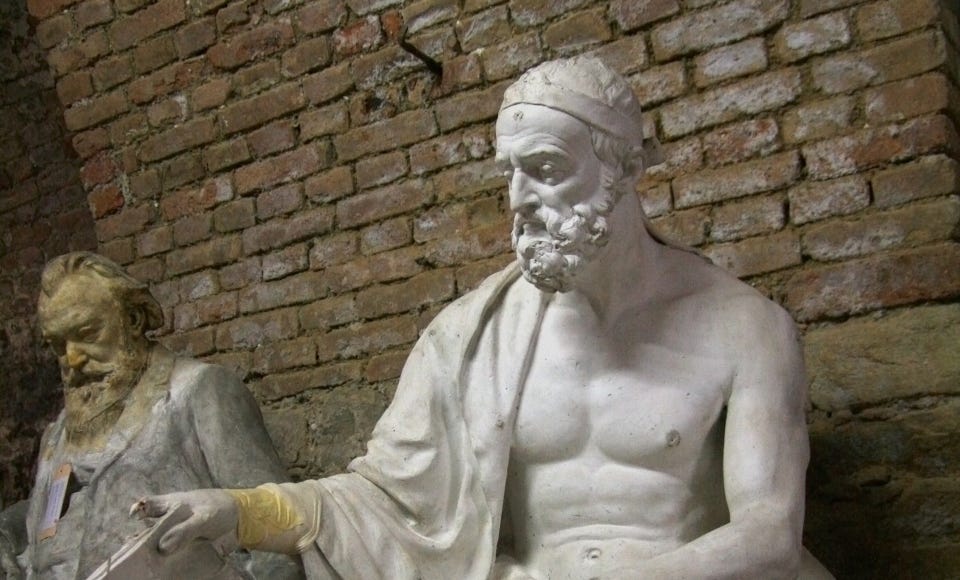
I’ve named this tool “Polybius,” after the ancient Greek historian who first theorized checks and balances in his history of Rome. Apparently, the name also refers to some kind of urban legend about an evil arcade game, but I didn’t know that when I chose it.
If you click here, you can see what Polybius says about the United States this A.M. As you can see, it seems to think the aftermath of the Pretti and Good killings was a big reversal for the regime.
Is this real? Well, I don’t really know! It’s an experiment. I’m sure even a cursory, non-expert glance will look at it and say, “This is missing a lot that’s important.” This is where I’d like help. I’ve provided the methodology and code here. I’m reaching the limits of my abilities: I took one course in college called “Quantitative Methods in Social Science” to get out of a math requirement; I do not know how to code; I do not have a PhD in sociology or political science. But I know many of my readers do have this expertise. If you are interested in refining or developing Polybius, let me know! I might create a Discord or some kind of bulletin board, where people can collaborate. Another thing: using Anthropic’s API is expensive, so I’m only gonna run this thing like once a day, get a score, which people can then check. I originally wanted to make this a search engine anybody can play around with, but that’s not really feasible at the moment. Maybe the coders can help. My only request is that you read the methodology and output closely before you start to give feedback.
Anyway, I think I will leave Polybius mostly in your hands now. If you want to tinker with it, have fun!


Hi John, I think the price of gold should be reflected in addition to the VIX index as a market signal.
While I'm not usually a fan of numerizing/quantifying socio-political matters, I still think this is an interesting attempt to grapple with the situation before us--and it sheds light on our big problem from yet another angle.
Readers here may be interested to read an Israeli attempt to numerize/quantify the assaults on democracy made by Netanyahu. See: "Netanyahu's 11 Moves Taking Israel From Democracy Toward Authoritarian Rule" in Haaretz, January 21 2026 (https://www.haaretz.com/israel-news/2026-01-21/ty-article-magazine/.premium/netanyahus-11-moves-taking-israel-from-democracy-toward-authoritarian-rule/0000019b-dbad-d4f5-a7ff-dfbd42160000 ). In this article, four different analysts numerically score Netanyahu on the following 11 categories:
* Restrictions on freedom of speech
* Persecution of political opponents
* Trampling the legislature
* The use of the security forces at home
* Violations of court rulings
* Trampling the watchdogs
* Declaring a state of emergency
* Control of the media
* Taking over academia
* Delegitimizing the opposition
* Exploiting the law to remain in power
Also of related interest is Jonathan Rauch's recent article in the Atlantic: "Yes, It’s Fascism" (https://www.theatlantic.com/ideas/2026/01/america-fascism-trump-maga-ice/685751/ ) in which the author discusses (without numerically scoring) Trump's activities for each of the following 18 categories:
* Demolition of norms.
* Glorification of violence.
* Might is right.
* Politicized law enforcement.
* Dehumanization.
* Police-state tactics.
* Undermining elections.
* What’s private is public.
* Attacks on news media.
* Territorial and military aggression.
* Transnational reach.
* Blood-and-soil nationalism.
* White and Christian nationalism.
* Mobs and street thugs.
* Leader aggrandizement.
* Alternative facts.
* Politics as war.
* Governing as revolution.