
This is a regular feature for paid subscribers wherein I write a little bit about what I’ve been reading and/or watching.
If you’re not yet a paid subscriber but regularly read, enjoy, or share Unpopular Front, please consider signing up. This newsletter is completely reader-supported and represents my primary source of income. And, at 5 dollars a month, it’s less than most things at Starbucks.
When the Clock Broke is now out in paperback and available wherever books are sold. If you live in the United Kingdom, it’s also available there. The UK edition is also apparently available all over the world, too! I’ve received reports now of book sightings in places as far as Kuala Lumpur, Malaysia, and Christchurch, New Zealand. It seems relatively easy to find in Commonwealth countries and at English-language bookstores abroad.
I also do a film podcast with Jamelle Bouie of The New York Times. On our Patreon, we have a lot of bonus content, including a weekly politics discussion.
The email address I gave last week as the LaRouche book “tip line” was incorrect—the correct address is johnganz@proton.me. Note that this address is specifically for that project; if you want to engage with something I write here, please use the comment section.
I’ll be on vacation starting next week and will likely be gone at least two weeks. I may try to give a travel dispatch from abroad, but I will not have my laptop, so it might be a little difficult. I’ll be sailing around the Ionian Sea, appropriately enough.—
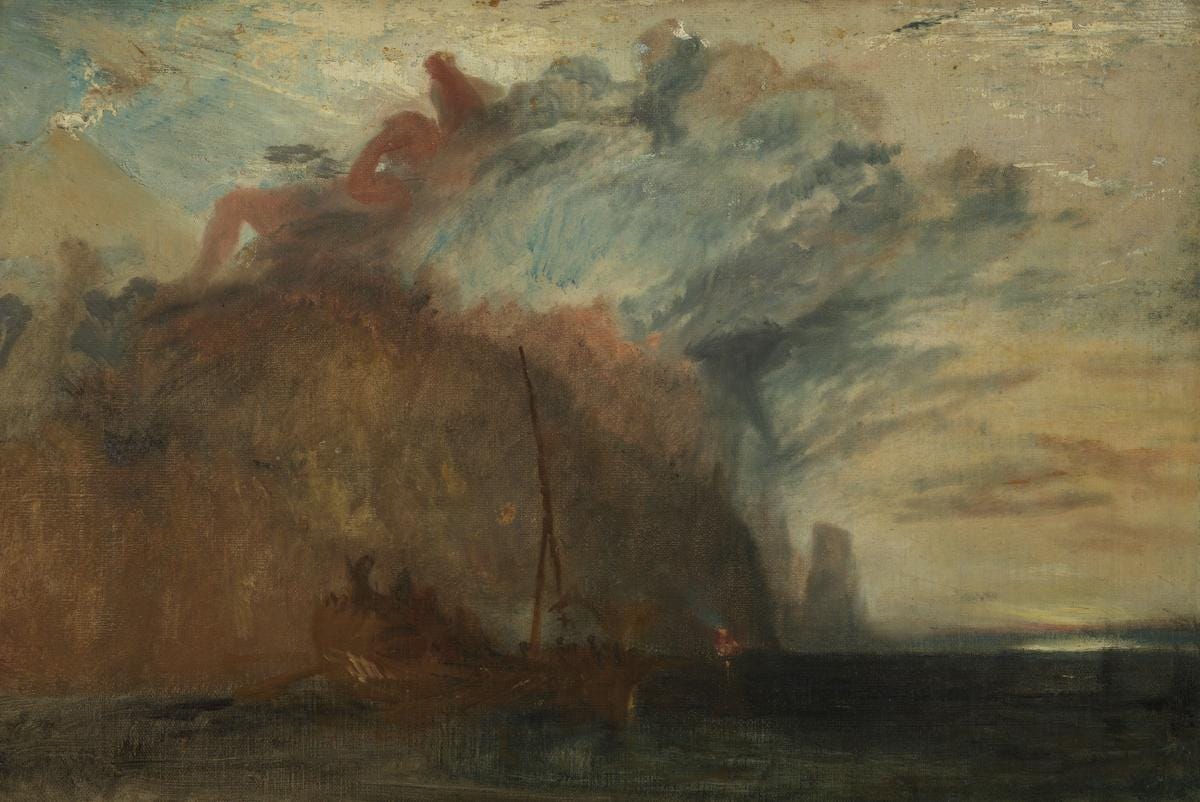
The whole country has Odyssey fever, it seems, and although I haven’t seen the new movie yet—I’m very skeptical about Hollywood adaptations of classics, but people do seem to love it—I’ve been doing some reading related to Homer’s epic. The reception makes clear that three thousand years after its composition, Homer’s epic remains a foundational text of our culture; its interpretations and reinterpretations are controversial. The online right, led by the cretinous Elon Musk, has been having a total meltdown over Nolan’s Odyssey, mostly because Helen of Troy is played by a black woman, and predicted that this “woke” Odyssey would fail at the box office. It’s impossible, therefore, not to feel a little schadenfreude as it breaks records worldwide. Watching this all unfold, I was reflecting on how differently left and right culture warriors respond to things they don’t like: “the woke” response to something is usually that the regressive attitudes within the cultural product are regrettably dominant; it’s a crisis, the sign of a backsliding culture that the offending material appears, and the fear is that the artwork in question will spread the social infection of racism, sexism, or whatever other -ism. On the right, they assume that the public at large actually shares their opinions, and that the Hollywood elites—you can put three parentheses on both sides of that—are foisting leftist propaganda on the masses, which will spontaneously and organically reject it. If you think about it, their positions are actually identical on some level: the public is a mob of drooling racists and films can whip them into a frothing rage—the right-wingers just happen to think that’s a good thing. It always turns out that for the most part normal people respond with a lot more good sense and proportion than the ideologues—it is, after all, only a movie. But, of course, the ideologues are right, too: these myths are still alive, they still structure our thoughts, so how they are represented matters a great deal.
Check out Daniel Mendelsohn’s review of Nolan’s film in the New York Review of Books:
Whatever its flaws, Nolan’s work indicated that he might indeed be the right person to take on Odysseus, another multifaceted hero characterized at once by admirable cleverness and dark behaviors, and the Odyssey, a text characterized by temporal disjuncts and narrative playfulness. The result, a $250 million, three-hour-long behemoth, the first movie to be shot entirely in the IMAX format, is, like Batman Begins, a darkly psychologizing updating of a classic; like Memento, it toys with themes of memory and forgetting while, like Oppenheimer, it twists a profusion of narrative and temporal arcs. And like the sack of unruly winds that Aeolus, the divine custodian of the winds, entrusts to Odysseus in book 10—only to have it opened by the hero’s suspicious crewmen, with disastrous results—it is in the end a mixed bag: at once a vehicle for the director’s virtues and, as with The Return, a case study of the weaknesses inherent in attempting to modernize a work many of whose values remain, for all its timelessness, stubbornly archaic.
The problem seems to be that he gave Odysseus a bit too much of an inner life—a gnawing conscience where Homer saw none. And he may not have even known the feeling, as our next reading makes clear.
In college, I found Erich Auerbach’s Mimesis: The Representation of Reality in Western Literature at the Dawn Treader bookstore in Ann Arbor; I had never heard of the book or Auerbach before, but I would buy anything that looked interesting. It turned out to be marvelous: Auerbach traces the entire history of Western literature, from The Odyssey to Mrs. Dalloway, and reconstructs the worldviews of the authors and their epochs. It begins with the essay “Odysseus’ Scar,” where Auerbach compares the style of the Odyssey to that of the Hebrew Bible:
