
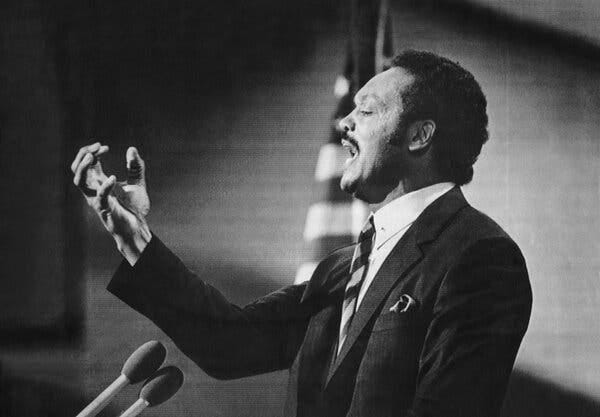
The Reverend Jesse Jackson died yesterday at age 84. Although in the past couple of decades, he was not the public presence he once was, it speaks to his stature that Trump issued what was, for him, at least, a remarkably appreciative and respectful statement in the wake of his death. In the 1980s and early 90s, the era in which Trump’s brain is stuck, Jackson was a figure of the first importance.
My book deals with the period just after Jackson’s political rise and chronicles his defeat and diminution by Bill Clinton. However, he was still a force to contend with, someone who required what Jackson called a “Machiavellian maneuver” to sideline. That maneuver is the now-legendary “Sister Souljah moment,” which is more invoked than understood. That was when, at a Rainbow Coalition event, Clinton attacked the rapper and activist Sister Souljah and criticized Jackson for including her in the Rainbow Coalition/PUSH conference. (In the wake of the Rodney King riots, Souljah had called the upheaval “revenge” and “rebellion” in The Washington Post and sounded a lot like she was defending the killing of whites to that end. For her part, Souljah said she was explaining, not justifying, the riots.)
As much as it showed Clinton’s cunning, “Sister Souljah” also demonstrated the tenuous ground that Jackson stood on. Sister Souljah represented a new, younger, angrier voice of activism, one that Jackson was trying to minister to and incorporate in his fraying coalition. Souljah had repeatedly criticized and mocked Jackson, but he felt he could not throw her under the bus without looking like a sellout and losing the youth. Even in his own time, he represented the past: he was a bridge to the Civil Rights era, rooted in the tradition of the Black Church. He also kept alive the hopes of the New Deal and the Great Society, of an “America [that] will get better and better,” as he said in his 1988 convention barn burner. Another misunderstanding about Souljah and Jackson: she was not his left flank; in important ways, she was to his right. Souljah represented a Black Nationalist tradition that stressed exclusively Black enterprise and a self-reliant rejection of the welfare state—she was much closer to Bill Clinton in policy proposals—while Jackson remained a stalwart tribune of American social democracy in the Reagan era.
There’s an argument to be made that Jackson signified the future of the left as much as its past, in a similar way that Pat Buchanan in the same era did for the right. In style, there’s no Barack Obama presidential run without Jackson, nor, in substance, Bernie Sanders’s primary campaigns. The multi-racial coalition building of Alexandria Ocasio-Cortez and Zohran Mamdani also owes him a great deal. And after decades of neoliberal domination, the populism and unapologetic New Deal liberalism of Jackson is finally back in vogue. The rank and file have come around to share his feelings on the plight of the Palestinians. There is still much to learn from his forgotten but successful antifascist crusade in Iowa, when he rallied farmers and defeated rising neo-Nazis. But in light of recent disappointing rhetorical performances on the left, there is one thing I wish they’d learn from Jackson: how to speak beautifully and persuasively in public. The rhetorical talent of Democratic politicians has fallen precipitously since Jackson faded from the scene. It was already not great then, and it is much worse now. As the conservative writer P.J O’Rourke wrote in his coverage of the 1988 convention: “He is the only living American politician with a mastery of classical rhetoric. Assonance, alliteration, litotes, pleonasm, parrellism, exclamation, climax and epigram — to listen to Jesse Jackson is to hear everything mankind has learned about public speaking since Demosthenes. Thus Jackson, the advocate for people who believe themselves to be excluded from Western culture, was the only 1988 presidential candidate to exhibit any of it.” Amen.
That irony is even more poignant today: As the right bangs its drums about defending “Western civilization,” all of its accomplishments and traditions, ethical and aesthetic—the King James Bible, Shakespeare, the Greeks, the Romans, the reformations and revolutions—were better embodied in Jackson than by any of the cheap thugs on the right who pretentiously invoke them without knowing a whit of what they are. As we say in the Jewish tradition, let his memory be a blessing.
This is lovely. Impossible to listen to Jackson speak without appreciating-and enjoying!-his command of rhetoric which, as you say, is a pillar of the much-vaunted "classical" tradition these jerks claim to venerate.
Trump has A Rhetorical Style, sure, but one that makes you feel sick to listen to - I always think of the parts of Macbeth where you can hear him losing his grasp on language, and what that says-or used to say?-about a king's grasp on power.
A good example of Jackson’s influence for me is that Mike Davis, toward the end of Prisoners of the American Dream, said that if social democracy were to come to America, it would be ushered in by a coalition a lot like the one Jackson was assembling.