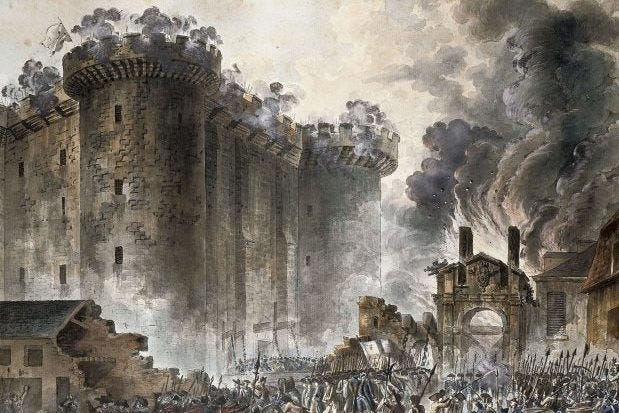
Today is Bastille Day
The French Revolution as It Appeared to Enthusiasts
Today is Bastille Day, commemorating the storming of the Bastille prison in Paris and the beginning of the French Revolution. I suppose The Revolution could be dated to the 5th of May, when the Estates-General convened, but that’s less exciting.
Henry Kissinger once asked Zhou Enlai what he thought of the French Revolution, to which Zhou responded, “Too Early to Tell.” Unfortunately, this sublime reply was based on a misunderstanding: Zhou thought Kissinger was asking about the recent 1968 student rebellions in France. It’s one of those “too good to check” moments where the apocryphon is better than the reality, because it’s true: the effects of the French Revolution are still unfolding, and the question remains open whether humanity is to be free or enslaved.
It was evident to observers at the time—especially those abroad—that the stakes of the Revolution were far greater than the question of which regime would prevail in France. Since my recent return to Arendt’s Eichmann in Jerusalem, I’ve been reading her Lectures on Kant’s Political Philosophy, where she quotes Kant’s remarks on the French Revolution in his The Conflict of the Faculties:
The revolution of a gifted people which we have seen unfolding in our day may succeed or miscarry; it may be filled with misery and atrocities to the point that a sensible man, were he boldly to hope to execute it successfully the second time, would never resolve to make the experiment at such cost-this revolution, I say, nonetheless finds in the hearts of all spectators (who are not engaged in this game themselves) a wishful participation that borders closely on enthusiasm, the very expression of which is fraught with danger; this sympathy, therefore, can have no other cause than a moral predisposition in the human race.
To Kant, the fact that people rooted for the revolution—for the idea of justice itself—without self-interest and even against their own self-interest, demonstrated the innate, disinterested moral capacity of human beings. The revolution symbolized the possibility—the inevitability, perhaps—of progress:
Now I claim to be able to predict to the human race--even without prophetic insight-according to the aspects and omens of our day, the attainment of this goal. That is, I predict its progress toward the better which, from now on, turns out to be no longer completely reversible. For such a phenomenon in human history is not to be forgotten . .
In his Philosophy of History, Hegel called it “a glorious mental dawn. All thinking being shared in the jubilation of this epoch. Emotions of a lofty character stirred men's minds at that time; a spiritual enthusiasm thrilled through the world, as if the reconciliation between the divine and the secular was now first accomplished.”
Putting the same sentiment in much finer style than Kant or Hegel could ever achieve, Wordsworth also wrote of the Revolution as a “dawn” in his poem “The French Revolution as It Appeared to Enthusiasts at Its Commencement.”
Oh! pleasant exercise of hope and joy!
For mighty were the auxiliars which then stood
Upon our side, we who were strong in love!
Bliss was it in that dawn to be alive,
But to be young was very heaven!—
Wordsworth's enthusiasm for the revolution would wane, as would that of his fellow poets Coleridge and Southey, much to the bitter disappointment of their former friend the critic William Hazlitt, who considered them base apostates. Hazlitt believed it was power, a “grim idol,” that stirred and seduced the imagination, not principle and right. The poets, in their different ways, sold out, according to Hazlitt, for money, for fame, or for the appearance of intellectual sophistication. As he writes of the trio in Political Essays (1819):
"And we saw three poets in a dream, walking up and down on the face of the earth, and holding in their hands a human heart, which, as they raised their eyes to heaven, they kissed and worshipped; and a mighty shout arose and shook the air, for the towers of the Bastile had fallen, and a nation had become, of slaves, freemen; and the three poets, as they heard the sound, leaped and shouted, and made merry ,and their voice was choaked with tears of joy, which they shed over the human heart, which they kissed and worshipped. And not long after, we saw the same three poets, the one with a receipt-stamp in his hand, the other with a laurel on his head, and the third with a symbol which we could make nothing of, for it was neither literal nor allegorical, following in the train of the Pope and the Inquisition and the Bourbons, and worshipping the mark of the Beast, with the emblem of the human heart thrown beneath their feet, which they trampled and spit upon!"--
This apologue is not worth finishing, nor are the people to whom it relates worth talking of. We have done with them.
Hazlitt believed, unlike them, he remained a “true Jacobin—”
A true Jacobin, then, is one who does not believe in the divine right of kings, or in any other alias for it, which implies that they reign "in contempt of the will of the people;" and he holds all such kings to be tyrants, and their subjects slaves. To be a true Jacobin, a man must be a good hater; but this is the most difficult and the least amiable of all the virtues: the most trying and the most thankless of all tasks. The love of liberty consists in the hatred of tyrants. The true Jacobin hates the enemies of liberty as they hate liberty, with all his strength and with all his might, and with all his heart and with all his soul. His memory is as long, and his will as strong as theirs, though his hands are shorter. He never forgets or forgives an injury done to the people, for tyrants never forget or forgive one done to themselves. There is no love lost between them. He does not leave them the sole benefit of their old motto, Odia in longum jaciens quae conderet auctaque promeret. He makes neither peace nor truce with them. His hatred of wrong only ceases with the wrong. The sense of it, and of the barefaced assumption of the right to inflict it, deprives him of his rest. It stagnates in his blood. It loads his heart with aspics' tongues deadly to venal pens. It settles in his brain--it puts him beside himself. Who will not feel all this for a girl, a toy, a turn of the dice, a word, a blow, for any thing related to himself; and will not the friend of liberty feel as much for mankind? The love of truth is a passion in his mind, as the love of power is a passion in the mind of others. Abstract reason, unassisted by passion, is no match for power and prejudice, armed with force and cunning. The love of liberty is the love of others; the love of power is the love or ourselves. The one is real; the other often but an empty dream. Hence the defection of modern apostates
On Bastille Day, make sure the Revolution is not forgotten, and be a good hater.


Would be interested to hear your take on Arendt's comparison of French and US Revolutions in On Revolution.
With all the soul-searching related to the Declaration's 250th - especially in the shadow of Trump, I can't help thinking Zhou Enlai's response is also apt regarding the American Revolution.
Showing my ignorance - what book(s) should I read to better understand the French Revolution?