
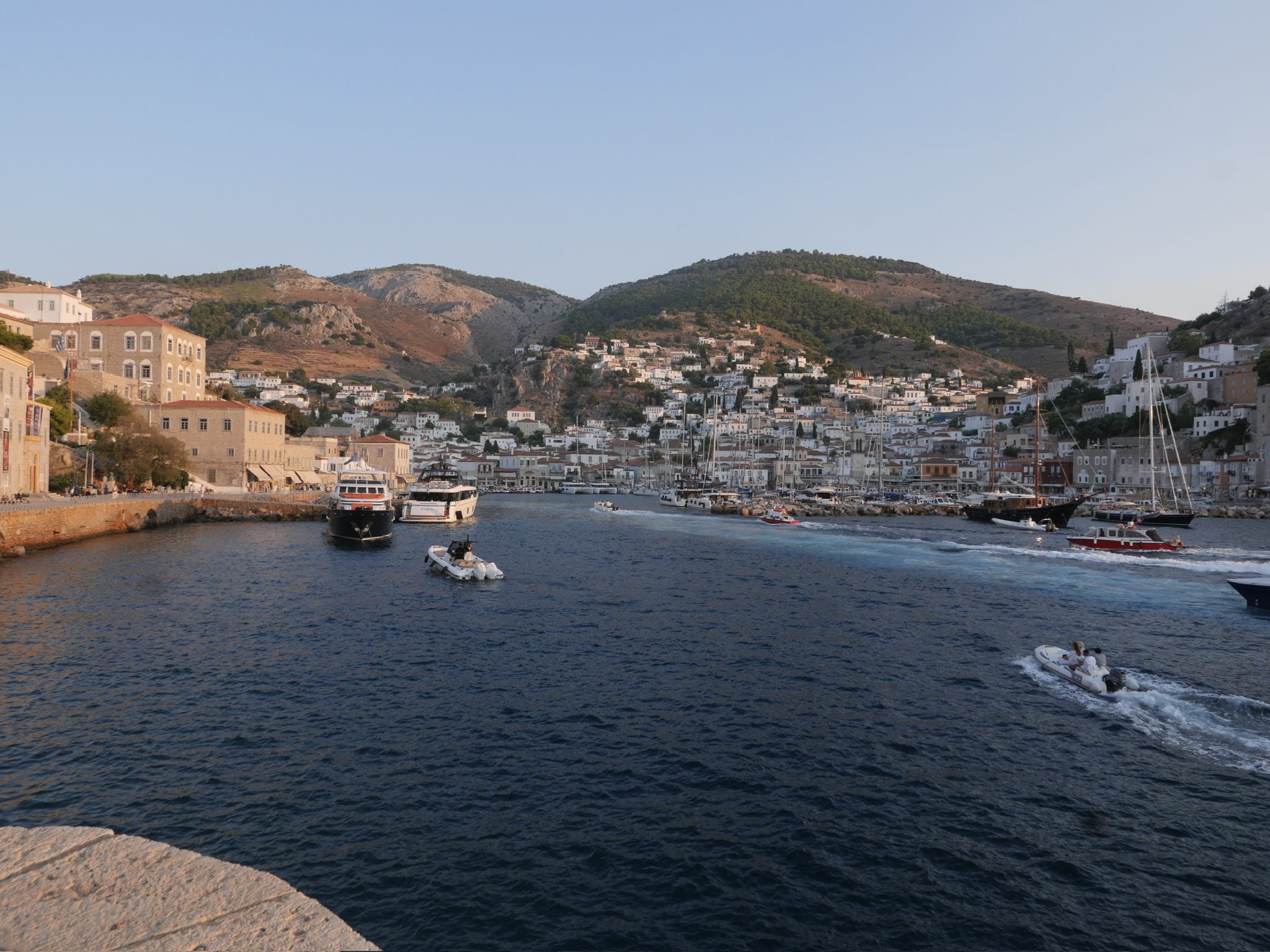
In the middle of my trip, I found myself on Hydra, a tiny island in the Saronic Gulf about an hour south of Athens by ferry. Although closer to its nation’s metropolis than many American suburbs, to land there feels like entering another time. This is no doubt because there are no cars permitted on the island—if you want to get your bags to your hotel, you need to hire a team of mules, or less romantically, a motorized wheelbarrow—and the strict local building codes keep the traditional architecture moored in the past. Most of the island’s permanent residents live in the town, known only as Hydra port, and more remote hamlets or beaches are usually reached by boat or mule. There’s also an Orthodox Monastery up in the mountains, but with 90-degree heat during the day, I decided it would be best to leave the monks alone with their contemplation. There are also apparently some nuns as well: I gave my seat at the ferry dock to a very aged sister who was helped to the port by what were evidently two very pious islanders, set apart from their fellow Hydriots working in the shops and restaurants by a more anachronistic appearance. The man had a terrific gray mustache and a button-down shirt left open to reveal tattoos with nautical and religious themes; he wore a small straw fedora, but a fez and a brace of daggers and pistols stuffed into a sash would not have looked at all strange on him. In fact, he looked strikingly similar to a print I bought and, then lost later in my trip, of a Hydriot sailor of the 19th century. As I got up, the ancient nun placed her hand on her heart and said efcharisto poli to me, a gesture I found very touching and gave me the chance to use the few Greek words I have, parakaló—both please and you're welcome.
There’s not much to do in Hydra except to get ferried to beaches, eat at tavernas, shop, and people-watch in the cafés at the port. Hydra, due to its charm and bohemian reputation, attracts many very fashionable visitors. Lots of ostentatious air kisses are exchanged in the port-side cafes where Parisians and Milanese act surprised and delighted to run to each other as if it were such a charming and unlikely coincidence that they’d both find themselves in such a place. As so happens everywhere, the merely genteel are chasing the merely fashionable who, in turn, are chasing the actual artists. Leonard Cohen and Henry Miller are the most famous examples, two creators who, whatever their own gifts and merits, have unfortunately cheesy cults surrounding them. Henry Miller wrote in his Colossus of Maroussi that Hydra “rises out of the sea like a huge loaf of petrified bread. It is the bread turned to stone which the artist receives as reward for his labour when he first catches sight of the promised land,” in a simile so bad that I now feel relieved for not having read him much. I’m more favorably inclined to his judgment that the island is “naked perfection,” as much a blessing as a curse as it becomes a can’t-miss destination of so many would-be aesthetes, myself included. For my part, I was much more excited to find out that Patrick Leigh Fermor wrote his book Mani, which I had in my backpack and just finished rereading, on the island, at the house of the painter Nikos Hadjikyriakos-Ghikas, sadly destroyed in a fire. There is, however, a museum and a very interesting one. It’s called the Historical Archives Museum of Hydra, a name which conjures up dusty reams of paper and perhaps mercifully fends off the tourists.

As you walk in, you are welcomed by the business end of the deck gun taken off a torpedo boat. This warns you of the strict naval discipline that prevails in the museum’s halls: I was strongly reprimanded by a guard about photography. The museum is in large part dedicated to the island’s glorious martial and political past; Hydra’s rich merchants funded the War of Independence, its mariners crewed its warships, and you learn that this tiny place provided more than its fair share of Greece’s admirals and prime ministers, whose imposing portraits line the walls. “See the urn that contains the ACTUAL HEART of our island's hero Admiral Miaoulis!” the museum website announces. The vitrines are filled with medals, old uniforms, and weapons—Turkish scimitars and yataghans, pistols from flintlock to revolver, rifles that ranged from mother-of-pearl-inlaid muskets to bolt-action knockoffs of Mausers of local manufacture, and models of ships that ranged from sailing men-o’-war to modern torpedo boats and destroyers commemorated for meeting ill fates at the talons of unfortunately more modern Luftwaffe bombers. Adult me was charmed; had I been taken as a child, I would’ve been enraptured, and my parents would’ve had trouble removing me from the place without tears and violent protestation.
More pacifically, there are also displays dedicated to local traditional costumes, and I was very taken with the silk Zostra that provided the sash for the men’s outfits. They are often a faded oxblood, purple, or magenta and have cords and stripes woven into them, sometimes with golden thread. They were equally useful in peace and war, when they could be loaded up with an array of knives and pistols in preparation for boarding an enemy ship. You can see one put to that purpose in the painting below of the famous Bouboulina, the Hydriot woman who became a hero of the War of Independence and perhaps the first female admiral:
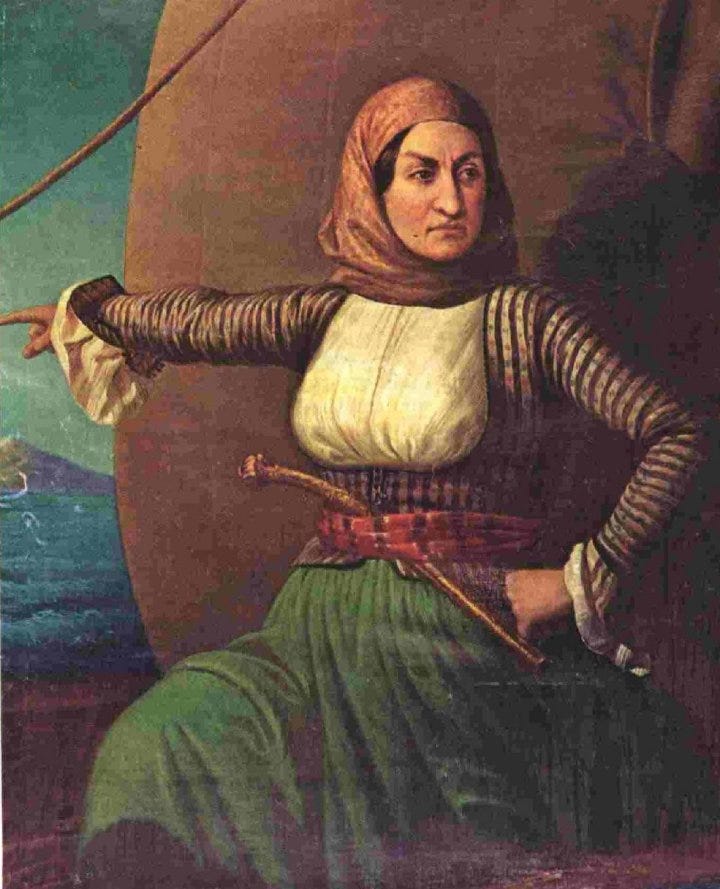
I’m not the first foreigner to find them comely: the famous portrait of Byron in Greek dress features him adorned with the textiles. I figured a knock-off of one would be easy to find in the port shops or one of the many tourist shops in Athens, and I could use it as a scarf, but it turns out they are very hard to find. Hunting for one led me to learn a lot more about the Greek silk industry than I’d ever thought I would. From what I can gather, they don’t really make them anymore. We expect even traditional textiles to have moved at some point over to mass production, with quality and substance lost but something of the original look preserved, but the weaving tradition and much of Greek silk production, for that matter, has died out. These magnificent objects were woven in the home, by women, for their dowries. The domestic loom and dowry weaving ended in Greece between about 1950 and the mid-1970s as rural people left the drudgery of village life. The introduction of artificial silk then destroyed most of industrial production, with the remnant centered around the city of Soufli in Thrace, the far northeast of the country.
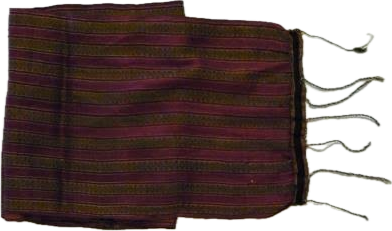
It’s easy to sigh over the loss of the Zostra, but it also must be considered that this loss coincided with the liberation of women from aeons of drudgery at their looms; uninterrupted, monotonous labor of untold generations of wives and daughters from Penelope to the near present. Odysseus’s wife would not have woven silk, though, which was introduced only in Byzantine times, around 500 A.D., by monks working for the Emperor Justinian I, who smuggled silkworm eggs out of China. I also discovered a more drastic and grim reason for the dying out of Greek silk production: the massacre at Chios in 1822. Chios was an important center of trade and silk manufacture in the eastern Aegean. It held a secure position in the Ottoman system, which made its people reluctant to join the revolt against the Sultan’s rule. Nevertheless, a small troop of revolutionaries from neighboring Samos landed on the island and attacked the Turkish garrison. Some Chiots joined the cause, but most stayed out. When the garrison was relieved by an Ottoman fleet, the reprisal against the population, most of whom had stayed loyal to the Sultan, was to be horrific. The island was totally sacked and pillaged. Four-fifths of the population of around 120,000 were either slaughtered, enslaved, or forced to flee. A gloomy reflection is due here that the present horrors in the eastern Mediterranean have so many fell precedents in the savage wars and revolutions of the Balkans, Asia Minor and the Levant during the 19th and early 20th centuries. Naturally, the domestic manufacturers were also destroyed, the looms shattered, the warehouses looted and razed, and most crucially the chain of traditional knowledge and practices violently severed. In response, the Greek revolutionaries mounted a counter-attack that resulted in the destruction of the Ottoman flagship in the harbor of Chios by Greek fireships, skippered by Hydriots. A model of a fireship—essentially a floating incendiary bomb that is driven into an enemy ship to light it ablaze—is a proud centerpiece at the Hydra museum, where a wall text connects the tradition of the fire ship all the way back to the mysterious “Greek fire,” the secret weapon of the Byzantines.
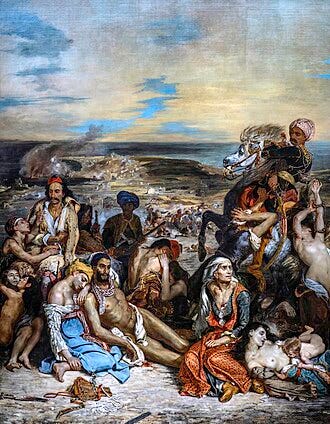
The atrocity on Chios, dramatized most famously by the painting by Eugène Delacroix, brought a wave of European sympathy and support for the Greek cause, including the fateful expedition of Lord Byron to the Ionian Sea, my earlier destination on my trip. But I’ll leave that till next time.
The great modernist painter, Brice Marden, and his wife, Helen, also lived in Hydra. Marden--a pioneer of abstract and minimalist painting, bought a house there in 1973; the sea, the stark rectangular lines of Hydra’s spare architecture, the blanching sun are visible in his work. See “ A New Yorker Bound to Greece--A Visit to Brice Marden’s Studio on Hydra” (greece-is.com).
Don’t forget the cats. We very much enjoyed our time there.