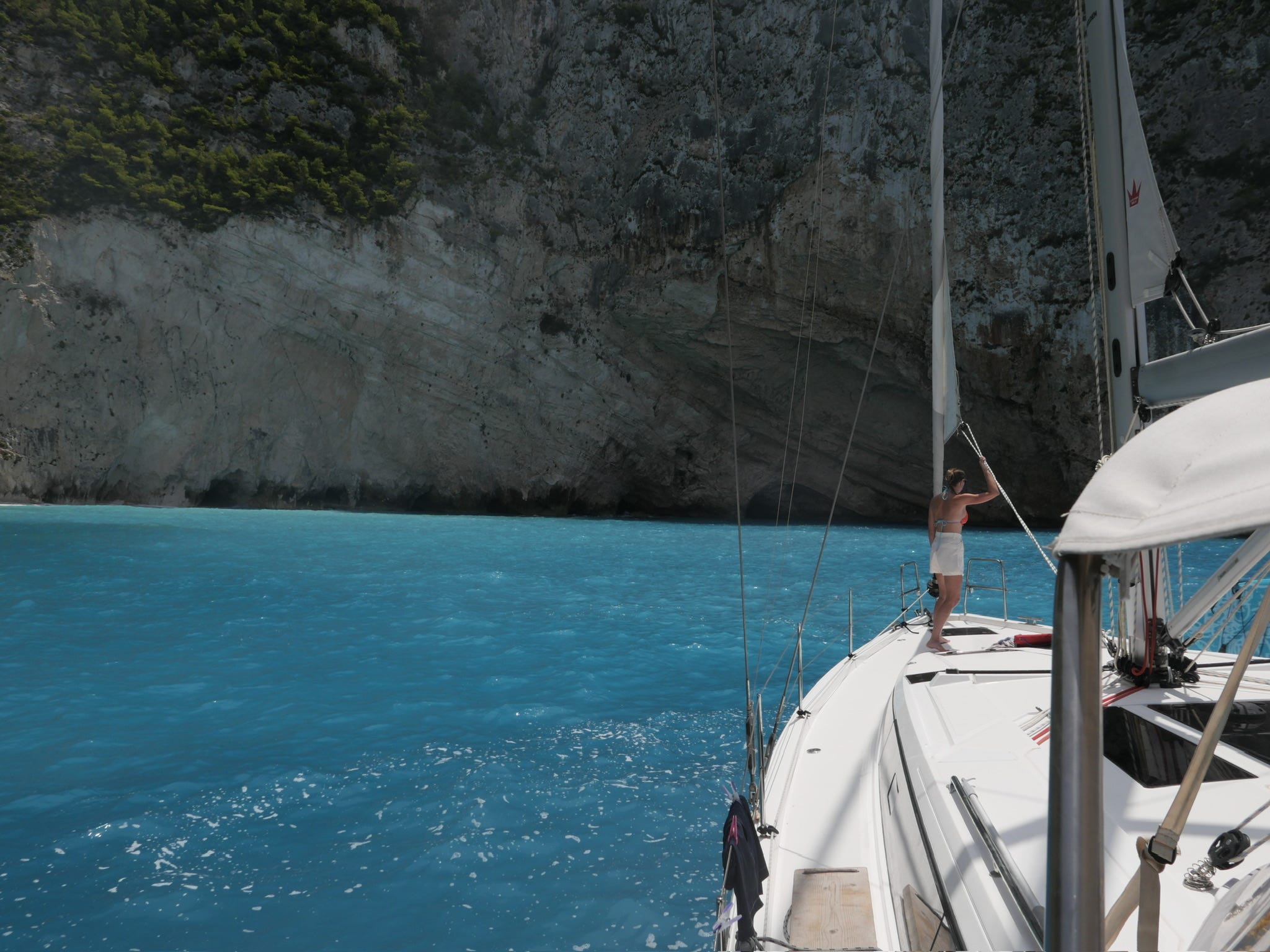
The first thing that happened to our boat in the Ionian Sea, appropriately, was that we were blown off course. We left from Sivotas, a little bay harbor on the south of the island of Lefkada, and wanted to make it to Atokos, a small island in the middle of the gulf that’s famous for a wild but gentle tribe of boars that lives on the beach and allows tourists to approach. The wind was not favorable to that attempt, so we decided to head immediately towards Ithaca, Odysseus’s fabled home. The wind changed again, and it took several hours of tacking to reach its coast, and one and a half more to enter the narrow channel between Ithaca and Kefalonia. Odysseus’s 10-year journey home no longer seemed so implausible. We could see the isle; it looked very close, and yet it continued to recede. We would approach, and then have to tack away. If it took us that long to go just a few miles, imagine the trip from the coast of Asia Minor, through the Aegean, around the Peloponnese, and back to the Ionian. And we had a boat with modern, triangular sails that allow you to cleave close to the wind, not the square-rigged bireme of the ancient Greeks, which is even more subject to the direction of the sky’s blasts. Of course, when you’re on vacation, being tossed about by the sea and waylaid is more fun than when you’re desperately trying to reach hearth and home.
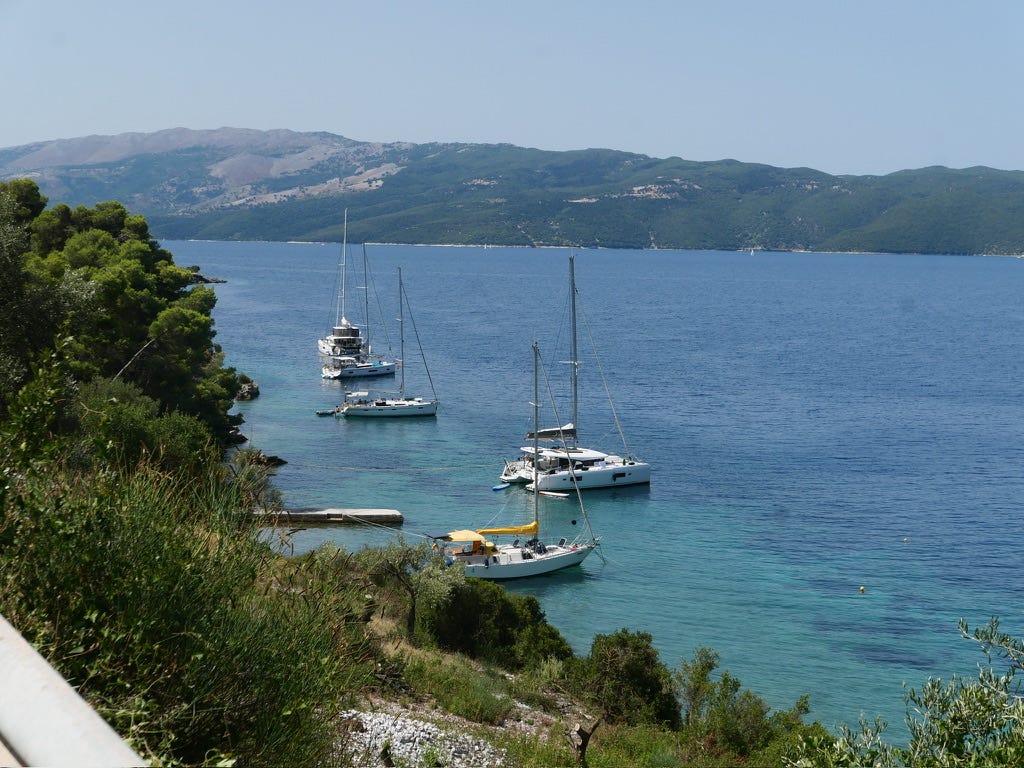
We eventually reached a little harbor in the channel between Ithaca and Kefalonia called Port Polis, which we chose because the sailing guide to the Ionian Islands we had onboard said it had easy access to the site of Odysseus’s palace. Polis turned out to be a small, pretty cove with a beach and a quay for fishing boats. It had a little taverna, really more of a cantina, whose only denizens before lunch were cats lounging in the sun. The staff there warned us that it was too hot to climb all the way up to the archeological sites near the town of Exogi, and that we should take a cab instead. The one taxi in the village of Stavros was busy, so we decided to ignore their advice and hike it. The phone said 40 minutes—not too bad.
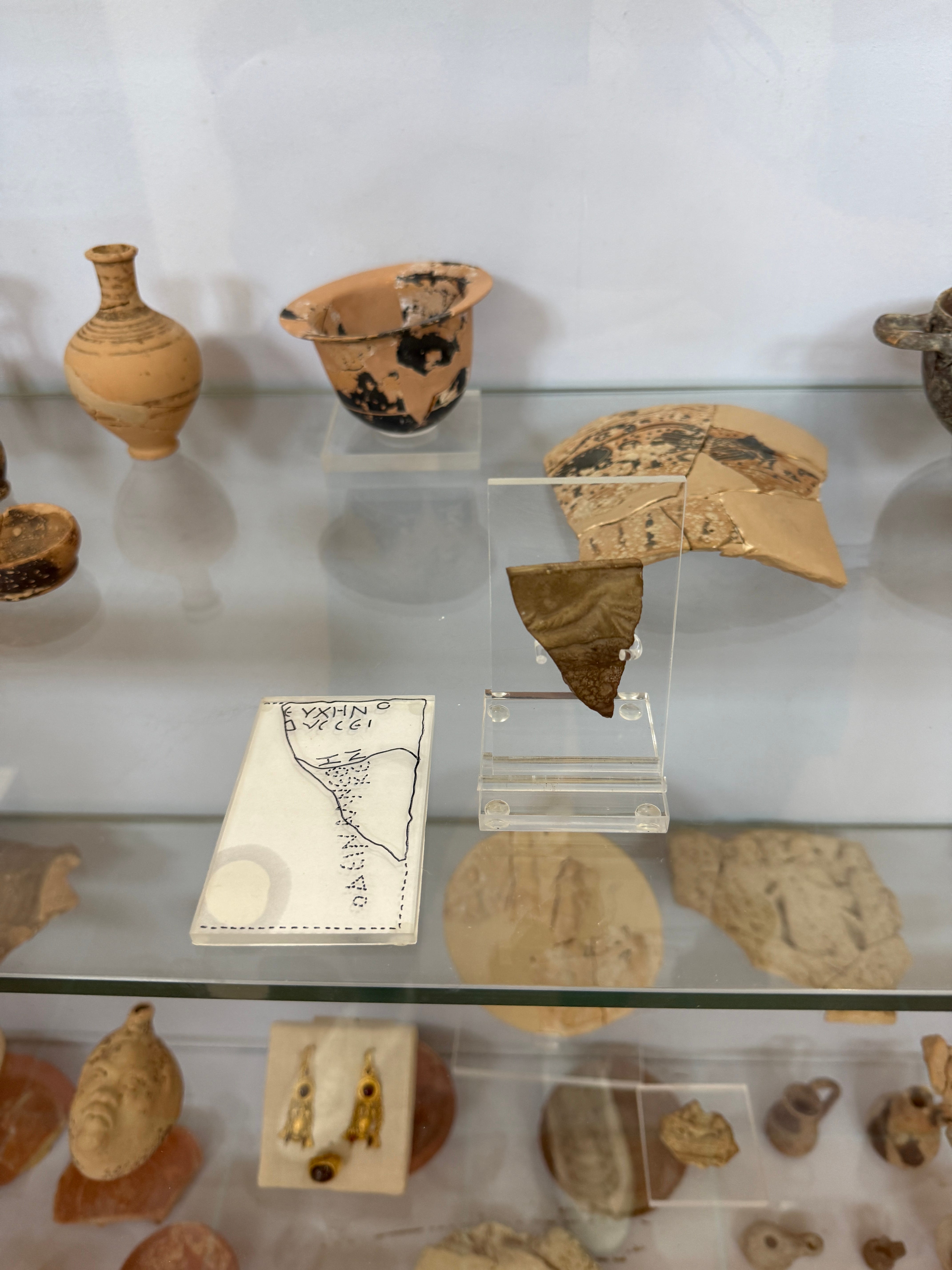
It wasn’t. Especially helped by a stop at the extremely tiny one-room archeological museum halfway, whose 5 euro fee felt justified for the momentary relief of air conditioning. The port was once the site of a cave, which had collapsed during an earthquake. The archaeologist Heinrich Schliemann, discoverer of the historical Troy, identified it as the cave where Odysseus hid his Phaeacian tripods upon his return to Ithaca, before Athena disguised him as a beggar. The cave had apparently been a site of continuous religious worship from the Mycenaean period to Roman times, and the museum had fragments of Bronze Age tripods that held the sacred fires. The cult appeared to center around the nymphs, presumably nereids, who resided in the caves, but the museum’s most treasured item was a tiny fragment of a ceremonial mask from Hellenistic times that bore the inscription “ΕΥΧΗΝ ΟΔΥΣΣΕΙ‘ — vow or prayer to Odysseus. The value seems to be that it conclusively linked the cave to Odysseus.
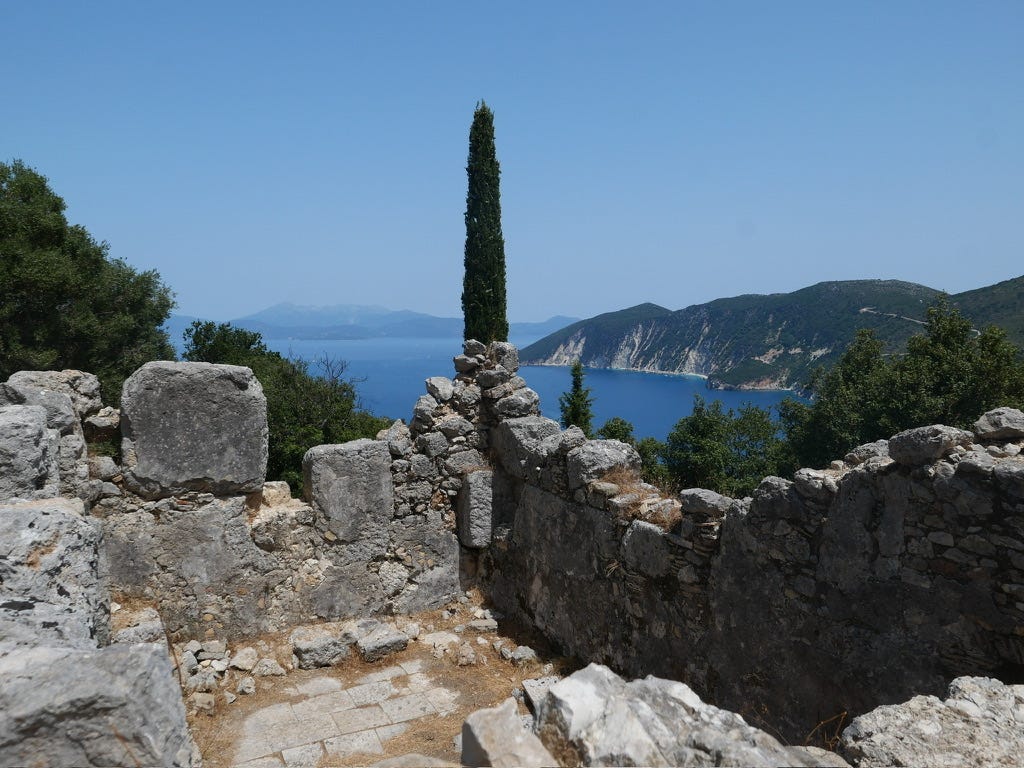
We continued climbing to the area marked with little fanfare as “archeological sites.” The great Schliemann failed to find Odysseus’s palace-city down near the village, but a site on the mountain above Stavros had been known since the 19th century as the “School of Homer.” In the 1990s and 2000s, there was a systematic excavation of the area, which revealed a much more extensive terraced complex with artifacts dating back to Mycenaean times. In 2010, archaeologist Thanasis I. Papadopoulos said “with every scientific reservation” that “we believe that we stand before the palace structure of Odysseus and Penelope.” Quite a claim. Just last year, the Greek Ministry of Culture concluded, with the discovery of tile fragments bearing the name Odysseus, that the entire area was an “Odyseion,” dedicated to the worship of the epic hero. This all suggests that the ancients also believed that the Mycenaean settlement on the site was Odysseus’s home. Good enough for me. It’s somewhat strange, but also refreshing, that it does not attract busloads upon busloads of tourists, especially after the success of Nolan’s Odyssey. That may change.
On the whole, the Ionian Islands seemed less blighted with tourists than the popular image of the Cyclades, but this perception may be because we spent so much time on our boat rather than in any of the villages or beach resorts. Ithaca in particular seemed sleepy and making only a half-hearted attempt to sell plots of land and houses to vacationers from Europe. The Ionian coast is not particularly easy to reach, at least from the United States: Athens is 4 or 5 hours away by bus and the only airport, Aktion Preveza, where I landed, takes only a few flights per week. It seems most popular with the Swiss, Austrians, and Southern Germans, for whom it is only a short flight away. Large stretches of our voyage, especially along the western coast of Zakynthos, were fairly desolate and free of human settlement. There was one popular sandy beach surrounded by cliffs with a shipwreck that attracted charter boats. And then many caves and coves, where the deep blue of the sea gave way to neon turquoise. Approaching those forbidding and impressive caves, with no other boats around, it’s not hard to imagine them inhabited by nymphs, goddesses, and monsters. Again, the inspiration for Odysseus’s voyage seemed easy to grasp. We attempted to approach one cove to anchor for a swim, but the sea nearby was rough and our skipper Max, my friend since we were about 10, deemed it too dangerous to get so close to the rocks. The place felt a little too enchanted, and I didn’t exactly feel disappointed when we started up the motor and chugged away. Encountering an angry nereid, disturbed after a slumber of thousands of years, felt entirely possible.