
Everyone has been sharing clips of Ross Douthat’s remarkable post-election 60 Minutes interview with Donald Trump. One of them, towards the very end of the segment, has Douthat press Trump on the state of his everlasting soul. Here’s part of the transcript:
Ross Douthat: Do you think you’re going to heaven?
President Donald Trump: I hope so. I don’t want to go to hell.
Ross Douthat: So I watched you at Charlie Kirk’s memorial service--
President Donald Trump: Yes.
Ross Douthat: And Erica Kirk, his widow got up--
President Donald Trump: Right.
Ross Douthat: and gave some very moving remarks about Christian forgiveness, how you have to forgive your enemies and your opponents--
President Donald Trump: That’s right.
Ross Douthat: And you followed her, and you said, and I know this was a little bit of a joke but I think facts come through jokes. You said, quote, “I hate my opponents and I don’t want the best for them.” Let’s say you pass away, you’re entering the next life, and all you have to do to enter paradise is feel love and forgiveness for James Comey, Nancy Pelosi, anyone who you have expressed hate for over the years. Do you think you can do it?
President Donald Trump: Well, then I wouldn’t be real, would I? I mean, if I said to you, sure, the easy answer to that is “Oh, yes, I could forgive.”
Ross Douthat: No, I don’t think it’s an easy question at all.
President Donald Trump: I found them to be extremely dishonest people, very bad people, very bad for our country. I love our country far more than I can love people and people like that.
Ross Douthat: Is the answer no then?
President Donald Trump: The answer is no. I want to be honest, no. I think it would--
Ross Douthat: Before the judgment throne of God?
President Donald Trump: Before the judgment. No, I think they were very bad people and-- I dislike, I can use the word hate, I do hate some of my enemies. I think they’re-- they’ve been terrible. Look what they’ve put me through, the weaponization. I got indicted--
Ross Douthat: You have fought-- Mr.--
President Donald Trump: --I got impeached--
Ross Douthat: --President-- Mr. President. You have had the most charmed and remarkable life of any American in my entire lifetime, and you are telling me you couldn’t find it in your heart to forgive some of your enemies? After all that’s been given to you?
President Donald Trump: I mean, it’s such an easy answer. All I have to do is say, “Yes, I can.”
Ross Douthat: I-- I, again, I don’t think it’s an easy answer--
President Donald Trump: Honestly, Ross, can I-- can I be honest--
Ross Douthat: --that’s why I asked it. Yes.
President Donald Trump: I probably cannot do that, no, because I do hate some of my enemies and I always will.
Being not myself of the Christian faith, although sympathetic to some of its tenets, I’ve never quite understood the piece of theology wherein a soul, in peril of eternal damnation, rejects God’s love and forgiveness and chooses Hell instead. As it says in the Catechism of the Catholic Church—“To die in mortal sin without repenting and accepting God’s merciful love means remaining separated from him forever by our own free choice.” Sounds bad! I didn’t understand it, because it seemed such an easy choice to avoid eternal torment, until now.
Trump was given that choice—granted, by Ross Douthat, who I’m sure is quite sincere in his faith, but we must admit is not St. Peter—and he chooses to continue to hate his enemies almost as a matter of personal authenticity. How could someone be like this?
Two things from the history of art occurred to me. One was the final scene in Mozart’s Don Giovanni, faced with the ghost of the Commendatore who tells him to repent, says no, and is dragged to Hell. Like Trump, he chooses a form of perverse integrity over repentance.
I also immediately thought of the souls that Dante and Virgil stop to talk to in Inferno, stuck forever, like animated friezes, repeating their state of sinfulness. As the great philologist Erich Auerbach wrote of the Divine Comedy, “We behold [there] an intensified image of the essence of their being, fixed for all eternity in gigantic dimensions, behold it in a purity and distinctness which could never for one moment have been possible during their lives upon earth.”
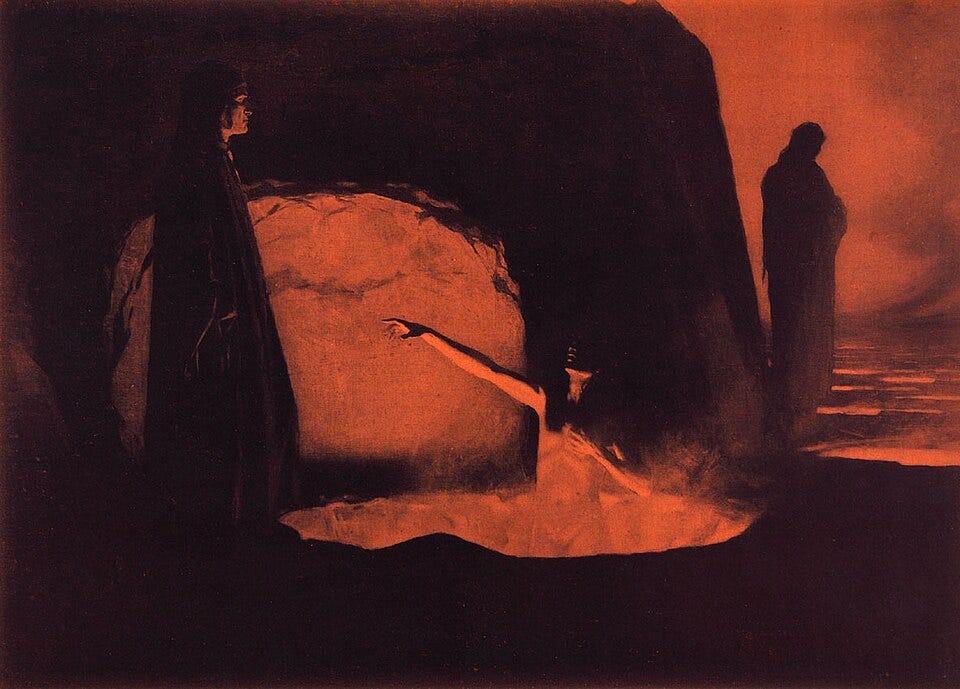
There are two episodes in the Divine Comedy that spring to mind. One is Canto VIII, in the Fifth Circle, among the Wrathful, where Dante and Virgil encounter the shade of Filippo Argenti, submerged in the mire of the river Styx. Argenti was a political enemy of Dante’s, one of the Black Guelphs who condemned Dante to exile from his beloved Florence. The soul of Argenti attempts to approach the poets, but Dante rebuffs and curses him; Virgil actually pushes him back into the muck of the Styx. Dante even asks to see Argenti further punished, and he gets his wish as other damned souls attack him, the perpetual fate of the Wrathful, who are locked in an eternal mud wrestle. For his violent denunciation of Argenti, Dante gets Virgil’s approval, including a little kiss on the face.
Virgil says,
Quei fu al mondo persona orgogliosa;
bontà non è che sua memoria fregi:
così s'è l'ombra sua qui furïosa.Quanti si tegnon or là sù gran regi
che qui staranno come porci in brago,
di sé lasciando orribili dispregi!He was an arrogant person in the world;
no goodness adorns his memory:
so his shadow is furious here.
How many now consider themselves great kings
up there who will remain here like pigs in the mire,
leaving behind horrible scorn!
It’s a strange episode, because at other points in his journey into Hell, Dante is moved to pity by the plight of damned souls. He also seems to be participating in the very sin that is punished in that circle—Wrath—in his demand for further punishment of the already suffering Argenti. Commentators point out that Dante really hated Argenti because he was a particularly nasty enemy, who may have even physically assaulted the poet and whose family confiscated property from the Dantes during his exile. Argenti was apparently a large, obnoxious bully who belonged to a clan of big Florentine bullies whom Dante blamed for the destruction of his beloved city’s political life. But beyond the personal satisfaction of placing your rivals in Hell, Dante must have a greater point. In the Comedy, each soul and its punishment encapsulates a particular sinful disposition and the world that sin forms. The wrathful Argenti creates, through his sinfulness, a world of hatred and constant antagonism. So perhaps Dante and Virgil are just momentarily entering that world of hate, but the episode strongly suggests that there is a meaningful difference between justified anger and sinful wrath. For one thing, it is not all-consuming—Dante’s spiritual journey continues—while Argenti finally turns his hate upon himself at the end of the episode:
in sé medesmo si volvea co’ denti.
He turned his teeth upon himself.
One need not believe in a literal world beyond to find value in Dante’s phenomenology of sin and punishment. In a sense, wrathful and arrogant souls —like Trump—are already pigs in the mire in this life; their shadows are already furious in the here and now. And it is very likely that despite considering himself “a great king,” “no goodness” will adorn Trump’s memory, and he will leave behind only scorn.
The other soul Trump reminded me of is a little later on, and is one of the most famous and most commented episodes in the whole Divine Comedy: the colloquy with Farinata degli Uberti, who actually even looks like Trump in a painting by Andrea del Castagno that depicts Farinata in a red hat. Dante and Virgil find Farinata in Canto X in the circle of Hell reserved for Heretics, where souls are condemned to lie in burning hot tombs. Farinata was a famous member of the rival Ghibelline faction who persecuted Dante’s White Guelphs. As Virgil and Dante pass his sepulchre, Farinata rises and demands to know who is speaking the Tuscan dialect. Farinata immediately also wants to know who Dante’s ancestors were so he can place him politically. Dante tells him, and Farinata immediately starts up a political argument with Dante:

Then he said: “They were fierce enemies of me, of my ancestors, and of my party, so that twice I drove them into exile.”
“If they were driven out,” I answered, “they returned from every direction, both times. But your people never learned that art very well.”
Their conversation is briefly interrupted by the soul of the father of one of Dante’s friends who shares the tomb and is anxious for news of his son, but then Farinata quickly returns to his harangue:
Continuing exactly where he had left off, he said:
“If my people have learned that art so poorly, that torments me more than this bed.
But the face of the lady who rules here will not be illuminated fifty times before you yourself will learn how difficult that art is.
And may you return to the sweet world above! But tell me: why are the people of Florence so merciless toward my descendants in all their laws?”
And I answered:
“The slaughter and terrible carnage that stained the Arbia red cause our people to make such decrees.”
He shook his head with a sigh.
“I was not alone in that,” he said, “nor would I have joined the others without good reason.
But I was alone, when everyone agreed that Florence should be destroyed, in standing openly to defend her.”
It’s almost funny that in Hell, Farinata is still fixated on his partisan struggles and makes excuses for his conduct. He even says his people’s lack of political skill pains him more than his infernal punishment. Some commentators find a tragic nobility in Farinata, and this is an understandable interpretation because Dante calls his enemy “magnanimo”—great-souled—certainly not an epithet Trump would easily earn. But I prefer Irma Brandeis's account in her wonderful little book, The Ladder of Vision. Why is Farinata the partisan in the circle of Hell for heretics, along with the Greek materialist philosopher Epicurus?
…we find in the dramatic encounter a presentation of heresy as not merely breach of that divine love which proceeds from God as well as toward him, and embraces all mankind—but a failure to maintain the essential unity (political and moral) of the earthly city. This failure occurs when the ego clings to some fraction or splinter of the whole, which it itself has nurtured. Epicurus clung to the splinter, mortal body. And Farinata? Farinata is a political partisan; a partisan soul, which, all deeds being past and done, yet embodies the spirit of faction and divides the city of man.
You can very easily say the same of Trump. Brandeis goes on to write,
The dramatic action of this canto of Heretics is, then, the dogged clinging to one’s own clan, one’s own side, with consequent failure to see humanity whole and to live in it accordingly. The “other” man is either an opponent (as the pilgrim is in Farinata’s view)….the sense either of injury received or triumph experienced obscures sympathy and undoes the soul’s equilibrium.
Trump also remains attached to his partisan identity and injuries even under the aspect of eternity; He makes hatred of political enemies the entire substance of his being, and relinquishing it would be an intolerable loss of self.
Trump’s hate is the product of his disordered love for himself over anyone else; His injuries and humiliations and their revenge are the most important thing to him. As Augustine wrote in the City of God, “Two cities have been formed by two loves: the earthly by the love of self, even to the contempt of God; the heavenly by the love of God, even to the contempt of self.” “For Augustine, the political expression of this love of self is libido dominandi, lust for domination, which pretty much sums up Trump’s entire personality.
Trump attempts to justify his hatred of his enemies in terms of patriotism—“I love our country far more than I can love people and people like that,” which reminded me of Machiavelli’s famous declaration, “I love my fatherland more than my soul.” I don’t think Trump is willing to risk his soul for love of country. It’s very clear, with Trump’s mention of impeachment and all the rest, that the concern here is him and what happened to him. He continues to rage at those who did not subject their wills to his own, and so he may, for all eternity. In the section of his Aesthetics where Hegel discusses Dante, he writes, “For as individuals were in their passions and sufferings, in their intentions and their accomplishments, so now here they are presented for ever, solidified into images of bronze.” Or, in the case of Trump, solidified into eternal bronzer.
There is the line from Milton - “Tis better to reign in hell than serve in heaven” which very much applies to Trump. Accepting God’s love and mercy requires submission to his will. That is not The Donald’s cup of tea.
Stephen Miller might be more unadulterated libido dominandi than Trump--more like Nero, in Augustine's description of the personality--in that his desire for domination isn't tempered at all by a desire for esteem. Trump wants the signs of a good reputation (monuments, etc) but Miller seems to enjoy being hated.