
Below is the text of my March 26th lecture at King’s College London. A special thank you to Steven Klein and Loubna El Amine of the Department of Political Economy for hosting me. And thank you, of course, to everyone who attended! As the talk was not recorded, this is the only documentation. Please keep in mind that these are notes, so there may be errors and typos.—
I was thinking when I was coming up with this talk, it would be crazy not to address the war, which perhaps is not so straightforward to deal with in terms of my book. From a certain perspective, it actually seems to create a lot of problems for one of its theses. Let me explain: part of the story of the political and social crisis that my book locates in the 1990s involves the factional struggle within the Republican Party and the Conservative movement between the paleoconservatives and the neoconservatives. Trump, on a very simplified reading of my book, ultimately represented the victory of this paleocon faction.
Now, since the neocons are the pro-Israel and pro-war guys, and the paleocons are the anti-Israel (and often antisemitic) and isolationist guys, you might think that this discredits my book. It seems like the neocons have triumphed again. So, Trump is not the avatar of a paleocon ascendency, QED.
But I’d like to think, on a more careful reading, the war in Iran is a product of some of the same forces and tendencies I identified in my book. Or at least, the book can still shed light on the present crisis.
Since I’m not going to assume you’ve all read the book or have very nerdy inside knowledge about the details of the American conservative movement, I’ll tell you a little bit about these groups. First, the neocons, which, despite their name, actually emerge before the paleocons. The neocons were liberals and leftists who defected from the left to the right in the 1970s. They moved rightwards because of their revulsion for the New Left on campus and their feeling that it, in particular, the Black Power movement, had become antisemitic. The Israeli-Palestinian conflict, or as it was then known, the Israeli-Arab conflict, is central here too, because the Black Radical groups openly identified and sympathized with the Palestinian cause in the wake of 1967 and 1973, angering many of their former Jewish comrades. The Neocons were also dedicated Cold Warriors, hawkish toward the soviet union, coming out of a perspective of anti-totalitarian anti-communism that viewed the USSR as a threat to democracy worldwide.
The paleocons claimed to be the real right, to be the genealogical descendants, often literally so, of an authentic American conservatism. They traced their lineage back to the prewar right, while they viewed the Neocons as essentially right-wing New Dealers. Murray Rothbard would sometimes even call them “mensheviks:”” I hope you don’t mind me quoting myself, but I don’t think I can put it any better than I wrote it. I was a much better writer then:
Two different visions of America divided these sects, or, to be more precise, two different versions of Americana. The neoconservatives largely still upheld the liberal mythos of America as the land of Lincoln and FDR. Self-consciously the sons and grandsons of immigrants, they championed the America of Ellis Island and the Statue of Liberty. They viewed the accomplishments of the civil rights movement as a point of national pride, even if they had a limited notion of it and often worked against the consolidation of its gains. They mostly believed that some form of the welfare state should exist, although significantly pared back from Great Society excess. Some were realists about foreign policy, but many believed that the United States had an obligation to spread democracy around the world—even at the point of a bayonet. To the paleos, the neos were just more representatives of the liberal modernity that they despised. And the neoconservative migra- tion to the right seemed a microcosmic repetition of the larger demographic changes to the country that the paleos decried. “The offensives of radicalism have driven vast hordes of liberals across the border into our territories. These refugees speak in our name, but the language they speak is the same one they always spoke,” wrote Clyde Wilson, Francis’s Tarheel conspiracy comrade. To Francis, the neocons were just “the right wing of the New Class” of managers and technocrats “engaged in an effort to moderate its collectivist and utopian dynamic with a strong dose of bourgeois liberalism.” Francis and his peers had come so close to power, only to see it snatched away by these upstarts.
Pat Buchanan had a soft spot for the idyllic 1950s, but for the most part, the whole postwar period was a scandal to the paleo mind. They traced their lineage to isolationist, prewar America Firsters. The New Deal, the Second World War, the civil rights movement, the Great Society, immigration, the New Left, the Vietnam War, opposition to the Vietnam War—all these things were deeply regrettable to the pa- leos and had changed American society almost beyond recognition. If the neocons held up mid-century New York as the height of U.S. civilization, the paleos wanted to go much further back: to the 1920s at least, and preferably back to the nineteenth century, to the world before Lincoln and the Civil War. While the neocons upheld statisti- cal research and the social sciences, the paleo intellectuals were mostly humanists who detested “managerial” technocracy.
The paleo aesthetic was American Gothic: white-sided Presbyterian and Congregational churches in small towns; stern, industrious folk; farmers, homesteaders, and frontiersmen. Added to this was the myth of the Gallant South and the Lost Cause. Many were Catholic traditionalists, but they praised the character-annealing rigors of the Protestant ethic. In the paleo junk shop of discarded historical forms, the dour Puritan Roundhead made a strange peace with the chivalrous Southern cavalier. Their imagination resembles nothing so much as the rainy-day transports of a boy who lines up all his toy soldiers from different periods in a grand alliance—here’s a knight, there’s a cowboy, here’s Davy Crockett, there’s a Special Forces commando. And for all its eclectic-yet-selective evocations of white civilizational virtue, the movement’s sentimentalism and romance was also steeped in Spenglerian gloom: the writing of this cohort of paleo thinkers is shot through with a deep cynicism, even nihilism, and a hard-hearted notion of power that questions democracy itself.
It goes without saying that the neocons were largely eastern and northern and urban, while the Paleocons were southern and western, and often rural.
So the first way I want to address Iran is by talking about Paleo “isolationism.” Isolationism is not quite the accurate label for the paleoconservative attitude towards foreign policy. The better term would be nationalist or sovereigntist.
We have to separate isolationism and unilateralism. Senator Robert Taft, whom the paleocons held up as an ancestor, the postwar link to the pre-war right, is a crucial figure here. Taft opposed NATO, opposed the Korean War, and opposed what he saw as Truman’s imperial presidency in foreign affairs, but he was not opposed to American power as such. He wanted a strong Air Force. He wanted American sovereignty unconstrained by alliances and institutions he saw as entangling the republic in other people’s quarrels. The Taft tradition is not “America should stay home.” It’s “America should answer to no one.”
The historian Tim Barker put this really well, I think:
The “isolationist” label actually makes it impossible to understand the precise dangers of a certain kind of right-wing foreign policy. The scariest thing about someone like Robert Taft was not his reluctance to go to war, but the fact that once he supported a war, he was willing to consider extreme forms of intervention. Taft made a bit of a fuss over the lack of Congressional authorization for the Korean War. But he soon became more frustrated with the fact that the war was stalemated, a situation he likened to “a football game in which our team when it reaches the 50-yard line is always instructed to kick. Our team can never score.”
Taft wanted to score, and to do so he was willing to countenance major escalation: “using Chiang Kai-shek’s troops in Korea or South China…the bombing of Chinese communications…perhaps imposing a blockade on the Chinese mainland…dismissing ‘any hesitation about the possibility that the Russians may come into the war.’” People like Taft especially liked nuclear air power, which they saw as an economical, capital-intensive, private-sector-friendly alternative to standing armies. “The ability of our Air Force to deliver atom bombs on Russia should never be open to question,” said the nation’s leading isolationist.
This is also maps onto Walter Russell Mead’s notion of a “Jacksonian” tradition in foreign policy—referring to Andrew Jackson, of course. Mead identifies Jacksonians as the folk-military culture of American nationalism — they don’t care about international institutions, democracy promotion, or liberal internationalist ideals. What they care about is a sense of American honor, American nationhood, and the willingness to use overwhelming and unapologetic force when either is threatened. Rubble doesn’t make trouble, they like to say. Jacksonians are not doves. They are conditionally, ferociously hawkish — the condition being that the fight be recognized as ours. And I should note that relatedly, Iran-hawkishness is really a big part of the institutional culture of the US military, particularly the Marines, because of the Beirut bombing. Revenge against Iran is for them a matter of honor.
Going back before the Jacksonian era, the paleocons like to talk about the founders and the Monroe Doctrine, of course. Here’s Pat Buchanan: “The message of George Washington’s Farewell Address was not to isolate America from Europe but to keep it independent of Europe. Stay out of foreign wars, Washington admonished. Look west to the mountains, the plains, the Pacific. That is where our destiny lies. Europe is the past. Avoid “permanent alliances”; devote your energies to your own country. Independence, not isolation, is the American tradition.” The Pacific is a key thing for this tradition; they were much more enthusiastic for the war against Japan than against Hitler and the Nazis, for a few reasons, but a major one being a notion of East Asians as a civilizational and even racial enemy.
Here’s how Sam Francis described what he wanted a paleo foreign policy to look like in the early 1980s, when Reagan was just elected,— He said his constituencies would “require protection against cheap imports and access to the raw materials and resources of the Third World, and they are less committed to international stability than to the continued predominance of the United States.”
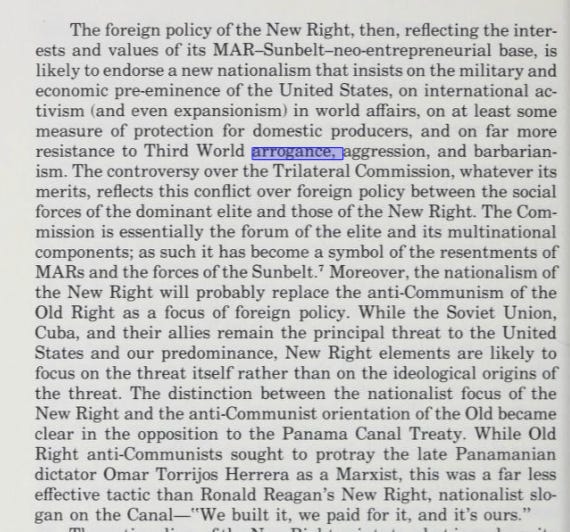
I mean, Francis here basically is summarizing the attitude of the Trump administration towards foreign policy. He saw it in advance, and many of the Trump people, the ones that can and do read, have read Francis.
Here we have the aggression, the unilateralism, not buying into international agreements, the naked resource imperialism, and even the fixation on air power—strategic bombing—to solve problems.
But I have to admit that this sounds good on paper, but it is not a fully satisfying explanation, because many of the more paleocon or America First figures, like Tucker Carlson, Nick Fuentes, or even JD Vance in Trump’s orbit or in the conservative movement at large, are the ones who still are opposed to the Iran war. Vance was quoted as saying something like “hit them fast and hard” which is sort of the whole Paleo war ethos in a nutshell.
But there are still a couple more ways to deal with this problem, I think. One is that there is less daylight between these factions, or subfactions of these factions, today than in the past. The Neocons also tended to have an unilateralist streak, and sometimes they let their mask slip, and the democratic globalist pretensions would give way to a more purely bellicose id.— “Every ten years or so, the United States needs to pick up some small crappy little country and throw it against the wall, just to show the world we mean business.” Said the neoconservative operator Michael Ledeen, by the way, one of the biggest Iran hawks in DC, who sadly died before he could see his dream come true.
The Norman Podhoretz branch of neoconservativism is a little earthier, raw and passionate, lets sa, than the Irving Kristol branch: Podhoretz was very impressed by Trump, associating him with a kind of bully that he saw on the streets of Brownsville and who could beat up people. Commentary under Podhoretz wasn’t primarily interested in building liberal international institutions. It was interested in will: American will, Western will, the willingness to identify enemies clearly and confront them without apology or hesitation. The target was always, at bottom, the liberal culture of doubt and accommodation — the McGovernite tendency, the Vietnam syndrome, the Carter years. Iran was almost constitutive of this sensibility. The hostage crisis, for neocons of the Podhoretz stripe, was the ultimate expression of everything wrong with post-Vietnam American liberalism.
Norman’s son John Podhoretz, and figures like him, have made a smoother accommodation with Trumpism. Norman’s son John Podhoretz, is pro-war, while Bill Kristol, Irving Kristol’s son, is now anti-war. Also, one has to consider the hollowing out of the conservative movement in general: the neocosnervatives started as a movement of intellectuals, but what remains is largely crude propagandists and hucksters, people like Mark Levin, who is a radio loudmouth.
There’s also something a friend of mine called the Buchanan to Bibi pipeline. A lot of younger members of the conservative clerical class who moved rightward in the past decade or so were first exposed to national populist or paleocon ideas and then became more friendly to Israel, which sounds paradoxical because Buchanan, of course, is an anti-zionist and a terrific antisemite. Some of this is pure careerism, but when you consider the failure and fading of liberal zionism in the US and the labor zionist tradition in Israel, and the open embrace of ethnic nationalism, and frankly openly genocidal, there is some ideological coherence. They often will talk about Israel as a “civilizational ally,” a kind of outpost of the West on the edge of the Eastern world. Of course, there has long been a philosemitic branch of White Nationalism. This is particularly evident in nationalisms that have a Calvinist background and therefore have a kind of spiritual kinship with Zionism,—So, some forms of American Protestantism—the Congregationalist lineage in the Northeast, Presbyterian and Baptist denominations in the South, and, of course, the kind of Christian Nationalism that Pete Hegseth is into. These Calvinoid nationalists can easily go from philosemitic to antisemitic when they decide they are the real Israelites. Boer nationalism was both antisemitic and zionist—lots of that about. And even here in the UK, naturally, there was a segment of imperialist thought that was antisemitic and Zionist. Winston Churchill is a prominent example here, who warned against International Jewry but supported the Jewish National Home in Palestine. That’s partly why Lord Montagu, the only Jewish member of Lloyd George’s cabinet, called the adoption of the Balfour Declaration intrinsically “antisemitic” and viewed the creation of Israel as the “world’s ghetto.”
But to bring us back from that tangent, there’s a strain of right-wing opinion that doesn’t care Israel is the “only democracy in the Middle East,” they view it as a white outpost, and are fascinated with it as an integral, militarized society, a garrison state, a Sparta.
Another thing we have to consider here, I think, is the role of Iran in the American popular, or to be more precise, populist, imagination. It’s perhaps not well remembered now, but the public anger about the hostage crisis was profound. It was a real humiliation for the American people; it reopened the not-quite-healed wounds of Vietnam. It contributed to Carter’s loss to Reagan, who was seen as tougher. Ross Perot, the billionaire businessman who ran a third-party campaign against Bush and Clinton and who is one of the principal figures in the book, and who I think is an important progenitor of Trump’s political career, became a kind of folk hero for his actions surrounding the revolution in Iran. Long story short: A bunch of Perot’s employees were jailed in Iran awaiting trial for corruption—charges which were almost certainly true‚—Perot was pretty open about bribing Iranian officials in the Shah regime, and Perot, frustrated with the lack of ability of the State Department to get his people organized his own commando raid, lead by a former Green Beret. They entered the country, but the State Department begged them not to attempt the raid, saying it would endanger other Americans remaining in the country, whether it succeeded or failed. They cast around for another solution, such as bribing an official. Events outstripped their efforts: the shah fled the country; Ayatollah Khomeini returned; revolutionary mobs descended on Tehran’s prisons; and the EDS employees walked out of their cells and into the Hyatt, where they met Simons and his team, who drove them across the Turkish border. Then he hired Ken Follett, an airport thriller writer, to write a book that dramatized the events called On Wings of Eagles. That book depicted the commando team as egging on the mob that busted them out of prison, which almost certainly did not happen. And then there was a television miniseries that depicted gunfights between the commandos and the guards. Definitely didn’t happen. So, against the unfolding hostage crisis, where the US government looks paralyzed, you have this businessman taking action. It made a big impression.
There was a country western song with the lyrics: “There ain’t no real-life heroes / Throughout this wretched realm / Where are you now when we need you, Ross Perot?” Letters of support from the public poured into Perot’s office. He wondered aloud if he should run for president. “No. King,” an employee joked.
Perot was opposed to the First Persian Gulf War, but not out of a sense of being dovish: he thought the US should have done a decapitation commando raid to take out Saddam instead. He shares with Trump something you might call “dumb guy epistemology.”
Trump himself has long been focused on Iran and especially the aspect of national humiliation. When he was flirting with running for president in the late 80s, he placed a full-page ad saying that the world was “laughing” at America’s leaders for their response to the Hormuz crisis brought on by the Iran-Iraq war. He did not like the multilateral aspect; he didn’t want the US protecting oil tankers we didn’t own with US ships — “protect ships we don’t own, carrying oil we don’t need, destined for allies who won’t help”.. You see, Trump does not understand markets at all—I just wanna make an aside here, he can’t really understand anything systemic at all, it’s all personal relationships and personalities.
I’m quoting Alex Barker in the Financial Times here:
Appearing a few weeks later at a New Hampshire rotary club event in 1987, Trump sneered about Iran’s navy being “little runabouts with machine guns” — had held America to ransom. “Why couldn’t we go in there and take some of their oilfields near the coast?” he asked.
In a 1988 interview with the Guardian: “One bullet shot at one of our men or ships, and I’d do a number on Kharg Island. I’d go in and take it.”
Of course, they are now considering doing just that.
I have a notion that I call the uneven and combined development theory of Trump’s brain, which is essentially that he’s stuck in the late 1980s and all of his policy ideas, insofar as you can call them that, originate a good deal from that.
As an aide, I think there is also an uneven and combined development thing going on with the Tech Right’s reactionary modernist program: they want to use advanced technology to reimpose a lost US hegemony or really domination, to return to an earlier era of US dominance and expansion.
I think at this point it’s also worth emphasizing the rhymes and the perennial nature of these themes in US history. First of all, there’s the weird rhyme with HW Bush’s foreign policy. Venezuela is like Panama 89 when we went in and took out Noriega, and then Bush I had his own Gulf War, which had much more ambiguous and complicated results. There is also the echo of US interventionism in the Cold War: largely successful in Latin America, with the exception, of course, of Cuba, but meeting greater difficulty in Asia.
And it’s striking that the debates, or the infighting now taking place on the American right, share the exact terms of the ones in the era of When the Clock Broke. The paleo movement itself really crystallized in opposition to the Persian Gulf War.
Just before the war, Pat Buchanan said on the McLaughlin group TV program: “There are only two groups that are beating the drums for war in the Middle East—the Israeli Defense Ministry and its amen corner in the United States.”. Buchanan named four Jews in favor of action against Saddam Hussein—A. M. Rosenthal, Richard Perle, Henry Kissinger, and Charles Krauthammer. As William F. Buckley Jr. pointed out later, he could’ve named Alexander Haig, George Will, Frank Gaffney Jr., or James Jackson Kilpatrick, but didn’t. On another episode of McLaughlin, Buchanan called Congress “Israel-occupied territory,” coming perilously close to the “Zionist Occupied Government” canard spoken of by neo-Nazis.` At the time those accusations were really off base: HW was perhaps the last representative of a WASP pro-Arabist tradition in US foreign policy, —Tucker Carlson is trying to bring it back with his TE Lawrence-inspired visits to Bedouin tents and so forth—and the war was fought on realist premises, rememberign the oil shocks of the 1970s, they were worried about the supply of oil being cut going into an election year. The oil shock was not reversible, and it tipped the US into a recession, which may be happening now, except we caused the shock.
Today, Buchanan’s case seems more plausible given what we know about Netanyahu’s role in pulling America into the war, and now a lot of the public seems to think so: this idea is basically held by the younger generation on the right. One can imagine that the paleo position is going to become dominant. Despite their money and institutional resources, the neocons are having trouble reproducing themselves. So that’s one way that the paleocon ascendancy thesis in the book is still an open issue. Just wait a little while more.
I guess if I had to criticize myself here, the problem would be just that I implicitly portrayed Trump too much as a culmination and end point of a process in American history, rather than just a continuation. History just doesn’t stop. And look, it seems very likely from what we know in the news that Trump was simply persuaded, if not tricked, by Netanyahu in particular, that this was all a good idea, but I don’t think the persuasion can happen outside of these contexts.
Before I finish, I also want to present one crazier, more speculative idea. I think it’s interesting to conceptualize MAGA as a white decolonial movement. Let me explain this a little: in Francis’s articulation of the paleoconservative ideology, America is under the thumb of a globalist managerial elite, and his Middle American Revolution is the heartland overthrowing that domination, which he sees as cosmopolitan and anti-national. As early as Reagan, he wanted “The New Right will favor a populist-based presidency able to cut through the present oligarchical establishment . . . whose values and interests are hostile to the traditional American ethos and which is a parasitical tumor on the body of Middle America.” And Francis’s position was not simply backward-looking and reactionary. In fact, it was revolutionary: he thought that the America First revolution would make America truly a nation for the first time. Of the right-wing radical violence that emerged in the 1980s, he wrote that its perpetrators were “in the process of articulating something that has never existed in America: a national myth, rising above and overshadowing private interests, to which a revolutionary right can adhere and for which its adherents would gladly spill their own blood and that of others.” Obviously, that sounds a little fascist. Francis takes these marxisant categories of class struggle and adapts it to his vision of nationalist revolution. He speaks of a nation within the nation: A downtrodden mass who has been dispossessed by managerial capitalism and its cosmopolitan ideologies. To the extent this speaks to a reality, you can understand it like this: there are in America, away from the coasts, many who have experienced what we are trained to see as American power and might as actually a decline in American status, a net loss for America. Trump speaks directly to this impression, and I think he genuinely shares it. So yeah, we can blow up anything in the world, we have vast financial resources, but we’ve gutted the center of the country, replaced its people and its values. For them, the high-water mark of American power was already deep in a period of decline.
Critics of the fascism thesis often point out that the fascist powers were secondary imperial powers who wanted to make a bid for preeminence against Anglo-American dominance, and as such, the analogy doesn’t really work with the global hegemon America. But for the constituents of Trumpism and MAGA, we are a declining power and need to reassert ourselves, both domestically and internationally. And you can easily see how compatible this notion of globalist cosmopolitan domination is with antisemitism. But here I’m gonna go out on a limb, but bear with me. In a way, the revolution that they envisioned and have carried out, albeit incompletely, is analogous to the Islamic Revolution in Iran.
I refer here to the work of the great historian of the Islamic Revolution, Ervand Abrahamian. Abrahamian’s great insight about Khomeinism — developed most fully in his 1993 book Khomeinism: Essays on the Islamic Republic — is that it cannot be understood as a form of traditional Islamic conservatism or “fundamentalism.” It is instead a species of Third World populism, structured around the same issues that produced Peronism, Nasserism, and other mid-twentieth-century movements of the postcolonial periphery. The division of the world into oppressors and the oppressed, the mustazafin against the mustakbirin, is not primarily theological. It is Manichean populism in Islamic dress — drawing as much, Abrahamian argues, from Marxist anti-imperialism as from Shia theology.
You might even say Sam Francis is to the MAGA revolution what Ali Shariati was to the Islamic Revolution, someone who used a quasi-Marxist framework to herald a reactionary, national revolution.
Abrahamian gives, I think, a very fine definition of populism that applies just as well to Trumpism and Khomeinism:
By populism I mean a movement of the propertied middle class that mobilizes the lower classes, especially the urban poor, with radical rhetoric directed against imperialism, foreign capitalism, and the political establishment. In mobilizing the “common people,” populist movements use charismatic figures and symbols, imagery, and language that have potent value in the mass culture. Populist movements promise to drastically raise the standard of living and make the country fully independent of outside powers. Even more important, in attacking the status quo with radical rhetoric, they intentionally stop short of threatening the petty bourgeoisie and the whole principle of private property. Populist movements, thus, inevitably emphasize the importance, not of economic-social revolution, but of cultural, national, and political reconstruction.
Now you have to make a few changes in the American case, because it’s not the urban poor, it’s the white working class etc. but it applies quite well I think. And Trump is the ultimate representative of a big petit bourgeois, a family business owner, a great little man, as Lowenthal and Guterman wrote in their book on American agitators.
Both movements emerge from a sense of profound national humiliation at the hands of cosmopolitan, modernizing, globally connected elites who are experienced as agents of foreign domination. In Iran, that elite is the Pahlavi court and its American patrons — secular, Westernized, contemptuous of traditional culture, enriched by connections to global capital, while the urban poor and the provincial faithful are left behind. In America, the paleocon and Trumpist worldview is remarkably isomorphic: a coastal, credentialed, globally connected elite experienced as contemptuous of heartland culture, enriched by free trade and financialization, operating as agents of a globalist project that has de-industrialized American communities and replaced their culture with cosmopolitan liberalism.
In both cases, the humiliation is simultaneously economic, cultural, and civilizational — and in both cases it generates a politics of resentment that is anti-establishment, anti-cosmopolitan, and intensely focused on the recovery of national dignity. Francis’s Middle American Radicals are, in this comparative light, a remarkably precise analogue to Khomeini’s mostazafin — the dispossessed majority who feel themselves humiliated by a corrupt and alien elite.
The Iranian Revolution and the American New Right are not just structurally parallel: they are also historically entangled. The hostage crisis is the moment where these two populisms, each built on a rhetoric of humiliation and restoration, collide directly. Iran’s revolutionary populism tries to reassert its dignity against the Great Satan. America’s nascent right-wing populism receives that assertion as the ultimate confirmation of its own narrative — liberalism means weakness, the cosmopolitan elite has allowed America to be humiliated, and only a restoration of sovereign national will can recover American dignity.
So, they are, in a sense, mirror images of each other. Each was formed around a wound that the other inflicted, or is imagined to have inflicted. Each offering its constituency a politics of restoration and dignity against a corrupt and cosmopolitan elite. Each, at its worst, is capable of tremendous violence in the name of that restoration. And now, nearly half a century later, that mirroring has produced an actual war — two populisms, each built on humiliation and grievance, finally meeting in direct violent confrontation, with the cosmopolitan liberal internationalist order that both despised now able to do nothing but watch. Of course, Trump is not a Khomeini or Khamenei, and that will turn out to be the decisive difference. The MAGA revolution, as this war has emphasized to some, is a bit of a mirage.
This explained a lot for me. As an old person I remember the eras you discuss here, but at the time I didn't really understand the neocon/paleocon split. Now I get it that my neighbors here in rural TN are paleocons resentful of their neoliberal and neoconservative elite overlords. I think the decolonial idea may be correct. It explains all the guns, and the backyard target practice that goes on almost every day here in nice weather. They see themselves romantically, as liberation soldiers, even though they are driving huge expensive trucks and live in big expensive houses that are heated or cooled year round to a comfortable 72 degrees. In fact the only time they come out to practice with their guns is when the outside temperature is almost exactly 72 degrees. Tough guys!
In my county the Republican petit bourgeois establishment has ruled the county uncontested for several decades. They have allowed right-wing thugs with swastika flags to terrorize drag show venues and black churches. But now, young Democrats are coming for them: every local office is contested by a Democrat for the first time in years! The Republicans, in response, are going full-on Christian nationalist: they are talking about "spiritual warfare" and the work that Satan is doing in this county, through the Democrats who are trying to undermine the county's moral values. They don't have any practical solutions to rising housing costs and rising cost of living generally, and they really don't care if young families can buy houses or not. So they say we Democrats are the Devil. The local churches echo this theme.
If we can get through the next year without any political violence, I will be very grateful.
This is fascinating, and I'm so pleased that it's NOT audio, as I read faster than I listen.