
It’s been a central theme of my analysis that Trump and Trumpism represent something new in American politics and that his style of politics and mode of governance represents a break with the past, but I must admit that a lot recently feels depressingly familiar. Naturally, one can’t hope to adequately catalog in a single newsletter the entire shameful history of United States intervention and meddling in Latin America. And there is, of course, the invasion of Iraq in 2003, but also more apposite precedents come to mind, like the now seemingly forgotten U.S. Invasion of Panama in 1989-90, when we seized dictator (and former US intelligence asset) Manuel Noriega and brought him to the United States to face drug trafficking charges.
It was a unilateral invasion of a sovereign country resulting in regime charge and justified on the grounds of “promoting democracy.” As such, historian Greg Grandin persuasively argues it was part of the path to the 2003 invasion of Iraq. When I was a young leftist, I remember it was the “Panama Deception,”—the title of an acclaimed documentary critical of that war—rather than the Persian Gulf that provided the paradigm of post-Cold War US perfidy and aggression and of the fateful interplay between mass media, militarism, and domestic politics. Even the name, “Operation Just Cause,” seemed to wink cynically at the double sided nature of American foreign policy: was it really a “Just Cause” or did we do it “Just ’Cause we could.”
One could argue what’s new here is the baldfaced and shameless imperialism; Trump openly says we’re gonna take the oil. In short, his major critique of US wars in the past is that they are not evil enough: We don’t pursue them for low enough motives nor with violent or underhanded enough means. All the pretenses about democracy promotion are now gone. The “deception” in question in Panama was that the United States pretended to care about Panamanian democracy and the human rights abuses of the wicked Noriega, when we really wanted control of the Canal. This is highly debatable. Historians now think domestic political worries about Bush’s image as a wimp contributed more than some grand strategic plot. As Grandin’s piece points out, it was a confluence of factors that pulled the administration towards intervention in Panama. Even the actors didn’t understand it in retrospect. Grandin: “Referring to the process by which Noriega, in less than a year, would become America’s most wanted autocrat, Bush’s National Security Advisor Brent Scowcroft said: “I can’t really describe the course of events that led us this way... Noriega, was he running drugs and stuff? Sure, but so were a lot of other people. Was he thumbing his nose at the United States? Yeah, yeah.”
Yeah, yeah.
So, now we do not even practice to deceive. What then is there for us “critics of ideology” to do when there is nothing left to unmask? But even this kind of open admission of material motive is not really new, although perhaps not it was not as crude—no pun intended. For just one instance, in the run up to Operation Desert Storm, both President Bush and Secretary James Baker openly talked about our reliance on Middle Eastern oil and preventing a recession and therefore the loss of US jobs. But then the administration’s rhetoric shifted, pointing to Saddam’s human rights abuses and how horrible his regime was in general. As the analysis of one historian contends, the public pretty much bought the oil explanation; the human rights stuff didn’t add much and may have even muddled the overall case, contributing to the rather short political gains of the war.1 So maybe Trump has some good reason to believe that being openly rapacious is a better political path than making up fairy tales about democracy and human rights. He even dismissed the possibility of opposition leader María Corina Machado taking over and signaled openness to negotiation with the remainder of the regime. Some have surmised that such a deal must have already taken place and that the entire operation was part of an internal coup.
But one then has to ask, even if “oil” is the openly stated motive, is it the real or even a compelling one? Things have changed a lot since the early 1990s and even the oughts; the United States is now a net exporter of oil. Our reliance on Middle Eastern oil, which brought us and others to such grief, is over. The assumption of good materialists is that some fraction of US capital is behind every imperial adventure, but does the US oil industry even really want this? Maybe yes. Maybe no.
Trump announced, “We’re going to have our very large United States oil companies, the biggest anywhere in the world, go in, spend billions of dollars, fix the badly broken infrastructure, the oil infrastructure, and start making money for the country,” The oil executives might blanch a little at the spending billions of dollars part. Fossil fuel analysts have pointed out the extremely high capital expenditures—tens and even hundreds of billions of dollars— would be required to increase production through Venezuela’s neglected infrastructure. American capitalists have been very reluctant in recent years to undertake any type of big capital expansion, let alone one in a very unstable and uncertain part of the world. The decline in oil prices makes a big capital investment even iffier for Big Oil. Chevron is the one firm that remained in Venezuela and is better positioned than its rivals, but has been notably a little circumspect: it’s preferred policy idea has always been the much easier course of dropping sanctions altogether and working with the regime. Their opponents in this effort have been Secretary of State Marco Rubio and Cuban-American lawmakers who advocate a hard line on Venezuela for ideological reasons. Barron’s reports that Chevron in general is hardly a big spender: “Chevron’s emphasis on capital discipline, including a tighter capex budget and a pullback in buybacks amid weaker oil prices, reflected a broader strategy to preserve free cash flow, not grow production.”
Nevertheless, Business Insider reports that some investors are already chomping at the bit, with a group of 20 already angling to get down south and see what’s available. These are smaller investors who are not as risk averse as their big corporate cousins, and one can speculate that this profile of firm is particularly suited to take advantage of what let’s call the informality of the Trump administration. Gulf Coast refiners, whose equipment is specially built for the heavy oil of Venezuela, also would want freer access, although, like Chevron, their preference has always been to end the sanctions. And it’s important to point out that not everyone in the oil business has identical interests. For instance, major Trump donor and oil tycoon Harold Hamm has been a strong proponent of sanctions to protect the price of crude, pitting him against the Gulf Coast refiners. Free flowing Venezuelan oil does not benefit him.
Suffice it to say, the oil lobby alone does not give us a unified theory of the action in Venezuela, although one could speculate that US actions might be an effort to cut the gordian knot of competing sectoral interests and impose a final solution to the Venezuealan oil problem that attempts to satisfy all parties: the majors get the capital they lost through Chavez’s nationalizations back, upstart klepto-capital buying Trump influence gets a chance to exploit the situation, Gulf Coast refiners get their Venezuelan crude, and Chevron’s bet on staying in Venezuela finally pays of. But this coherence is itself incoherent. There is really no way resolve all the sectoral contradictions in the oil industry. And such a settlement would require a vast, durable legal and bureaucratic reconstruction of property rights, debt hierarchies, and regulatory authority on top of massive capital expansion. In other words, the sort of state capacity that this administration not only lacks but has actively worked to dismantle. (I’d also like to humbly re-submit my “uneven and combined development” theory of Trump’s mind here—the idea of oil is appealing to him because he comes from an era where it was all important. And I’d also point out that Panama happened at the exact point where I believe Trump’s brain broke.)
So much for vulgar Marxism, but how about possible geopolitical strategic rationales? This is implied by the invocation of the “Donroe Doctrine.” Here we don’t need to run Venezuela, we might not even want to, we just need to make it unusable for anybody else. United States policy may be to undercut Russian and Chinese global positions and this would require not any real effort to rule Venezuela so much as to the threat to ruin its efforts to align with any other power. “If you get out of line, we’ll fuck you up,” would be in keeping with Trump’s outlook and a return to “spheres of influence” logic. In this dark vision, the prospect of an unstable or collapsed Venezuela is not really a policy failure at all. The fact that it would take years to fix the infrastructure or that US corporations might be reluctant wouldn’t be a problem either. Imagine if you will, the Atlantic City of Oil, but on purpose.
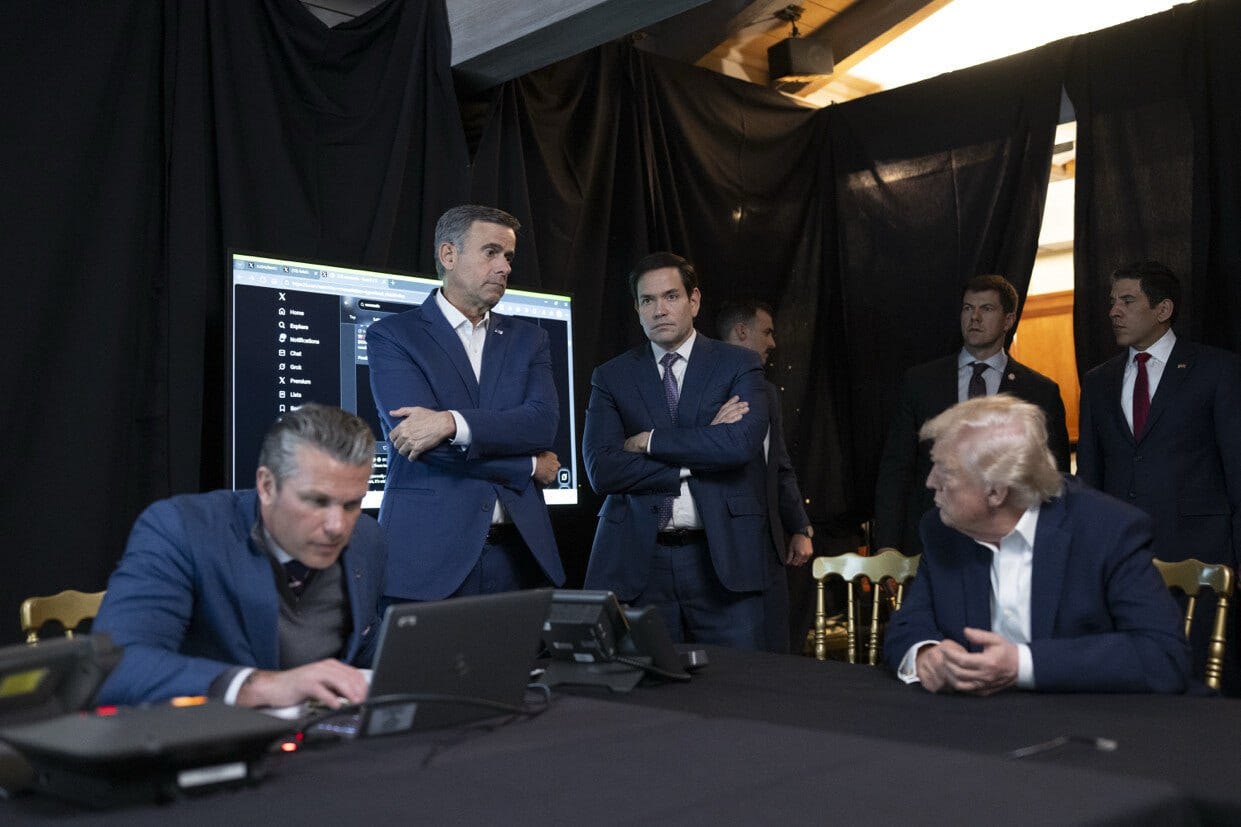
More immediately, there is the factional make up and political situation of the Trump administration to be considered. As the New York Times recently reported, the military strike in Venezuela was propelled by an unholy alliance between Marco Rubio’s neocons and Cuba hawks faction, Stephen Miller’s desire for an expedient to accelerate deportations through the invocation of the Alien Enemies Act, and the administration’s campaign promise to do something about drugs, particularly fentanyl. The fact that Venezuela doesn’t produce fentanyl apparently wasn’t a real obstacle, which strongly suggests that mere spectacle is huge motive here. Look at the image at the top of the “war room.” They had Twitter-excuse me, X—open during the operations. As the administration struggles politically, the imagined propaganda value of this can’t really be underrated. They are desperate for “wins.” And they have a weak leader uncertain of his own aims likely to be swayed by factional intrigues, especially when the plots can provide some spectacular content—Trump was going on about how it looked like a movie while talking to Fox News.
Here I’m going return to the fascism analogy. Foreign adventures in the wake of domestic failure is a recognizable pattern. Mussolini was driven to the Ethiopian war out of the “domestic stagnation” of fascism. Like in the United States, the imperial project had existed under the previous liberal regime, but had stalled out and this was a way to Make Italy Great Again, if you’ll permit me. The real risk is that if this seems to buoy the Trump administration and the Republicans politically and solve rather than deepen their factional disputes, then we can imagine more bellicose gambles of this kind. Despite Trump’s long vaunted shyness about protracted conflicts, his hubris might get the better of him—and us. A war for oil might be more rational and coherent than what’s actually taking place.
Hurst, S. (2004), The Rhetorical Strategy of George H. W. Bush during the Persian Gulf Crisis 1990–91: How to Help Lose a War You Won. Political Studies, 52: 376-392. https://doi.org/10.1111/j.1467-9248.2004.00485.x
There was an article in Politico about the Trump administration pressuring the oil companies to go into Venezuela.
The interesting part for me was this, quoting a major oil company executive:
“Will the U.S. be able to attract U.S. oilfield services to go to Venezuela?” the executive asked. “Maybe. It would have to involve the services companies being able to contract directly with the U.S. government.”
So it might be a risk-free expedition for the oil services companies paid for by the US government.
It wouldn't surprise me if the US got control of receipts for Venezuelan oil, perhaps opening an account in the Federal Reserve Bank of New York similar to the "Development Fund for Iraq" established in 2003 with UN approval.
As is known now that money was disbursed with few controls. I could tell some stories about that. There was a lot of illegal and legal looting, the latter by contractors like KBR and Parsons taking advantage of cost-plus contracts without clear scopes of work.
I'd bet there are some drooling over the prospects.
i think the garbled motives are fourfold:
1. principally content creation* and ensuring the ragebait flows; the spectacle must go on;
2. arbitrary rampage and brutish display for its own sake; the primal father reinscribing hierarchies of disposability;
3. gender insecurity and racial bloodlust (hegseth and miller);
4. settling old scores (rubio) and grubby wheeling dealing (oil).
*some proposed nomenclature via bluesky: governtaiment, clicktatorship, lolviathan, algorithmic plebiscite, etc