Little Red Scare 2.0
Old Wine in New Bottles
Yesterday, July 20 2026, the State Department released a report entitled Cuba: The Capital of 21st Century Communism; on Twitter, the Secretary of State Marco Rubio announced, “For more than six decades, the Cuban regime has been the leading sponsor of radical leftism and Third Worldism in the United States. The State Department is exposing the full history of Cuban espionage and subversion in our country. The American people deserve to know." This comes just days after the “Ministerial on the Resurgence of Political Terrorism” hosted by Rubio, which featured representatives from over 60 nations and speeches from Scott Bessent, Kash Patel, and Stephen Miller, who lent his Nazi rhetorical stylings to the event, saying
"This is a fatal cancer to civilization. And the greatest risk that we have is that our institutions have grown too soft and too cowardly to be able to defend themselves against a mortal threat. If your civilization is your home, you must defend it with the same passion and force as if an enemy intruder is inside your own house where your family lives.
The report specifically targets DSA as a “particularly potent illustration” of these supposed Cuban influence operations—although it has to admit that the group "was not shaped by the direct and tangible influence of the Cuban government" and has "organic ideological commitments," but insists this does not mean the group is free of ties to the Cuban influence network — it cites delegation to Cuba as evidence. This, along with Miller’s dismissal of the left’s “completely pretextual and disingenuous appeal to civil liberties, Rubio’s vow that terrorist designations would come for left-wing groups “soon,” and the report’s own invocation of “blacklists, McCarthy-era investigations and prosecutions,” has many on the left justifiably anxious about both domestic political repression and a pretext for military action against Cuba. I don’t want to dismiss these concerns, but there’s a more recent precedent than the Second Red Scare worth considering—the “Little Red Scare” of the Reagan era.
Shortly after Ronald Reagan’s inauguration, on April 24, 1981, the newly formed Senate Subcommittee on Security and Terrorism convened its first hearing on “Origins, Direction, and Support of Terrorism.” The “SST,” or “the Denton Subcommittee,” after its chairman, freshman senator Jeremiah Denton of Alabama, was formed by Judiciary chair Strom Thurmond as an attempt to restore the functons of the old Senate Internal Security Subcommittee—the upper chamber's counterpart to HUAC, the McCarran-Eastland operation that had run the Senate's side of the postwar red hunts— which reform-minded post-Church Committee Senate had finally abolished in 1977, along with the House's internal security committee two years earlier. The subcommittee would consist of Denton, John P. East of North Carolina, and Orrin Hatch of Utah in the majority, with the minority represented by Patrick Leahy of Vermont and Joseph R. Biden of Delaware in the minority; chief counsel was former FBI man Joel S. Lisker.
To the New Right, this abolition was unilateral disarmament in the still-frosty Cold War—and it removed a valuable cudgel against the domestic left. The Heritage Foundation’s Mandate for Leadership transition plan called to “revive the committees"“ and to rebuild of the internal security apparatus to battle domestic subversion, warning that clergymen, students, businessmen, entertainers, labor officials, journalists and government workers may engage in subversive activity "without being fully aware of the extent, purpose or control of their activities," and that individual liberties are "secondary to the requirement of national security and internal civil order.” The author of this section was one Samuel T. Francis, who would go on to be a staffer for John East.
“Third Worldism” was already a big fixation back for the Denton Committee and its staff in 1981. In a review of Claire Sterling’s Reader’s Digest press book The Terror Network: The Secret War of International Terrorism, Francis wrote:
It is highly doubtful that the Soviets seriously think that terrorist groups can bring about a revolution in the advanced economies; that is not their purpose. Rather, the front line lies in the “national liberation movements” of the Third World, on which the “imperialist economies” are dependent. By supporting terrorism in western Europe and North America, the Soviets intend merely to develop a cadre of politically cooperating elements that, in both their violent and non-violent activities, express solidarity with the national liberation struggles and destabilize the “imperial states.” The struggle against imperialism is a constant theme of terrorist propaganda, and it is crucial to understand that the primary target of terrorism is not the regime of the “imperial state” itself but its economic and political relationship with the “colonized areas” in revolt
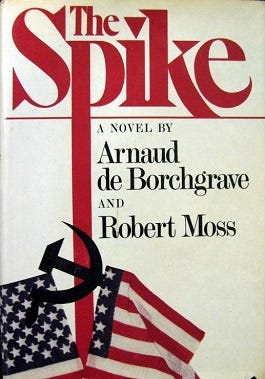
The first witnesses to the committee were Sterling, former Director of Central Intelligence William Colby, Michael Ledeen—remember him?—and a Belgian journalist and spy novelist named Arnaud de Borchgrave. He was actually Count Arnaud de Borchgrave. He ran away at fifteen to join the British Royal Navy, then spent three decades as Newsweek’s glamour correspondent: Paris bureau chief at twenty-one, eventually chief foreign correspondent, covering by his own count seventeen or eighteen wars and interviewing seemingly every head of state on earth. His physical appearance was famous and a little absurd—permanently bronzed, immaculately tailored, a man built for hotel bars in Beirut and audiences with Sadat—the press corps aristocrat as a type that no longer exists. Newsweek pushed him out in 1980 after thirty years. Borchgrave concluded, apparently sincerely, that his defenestration was itself evidence of the thing he’d been warning about — Soviet penetration of Western media reaching into his own newsroom. In 1980, he published a roman à clef with Robert Moss called The Spike, which outlined his belief that what passed for news in the US was the product of KGB psychological warfare operations. Senator Denton took this novel as the blueprint for the Subcommittee’s work. “Denton believes The Spike”. He has concluded that the press is advertently and inadvertently in league with the Communists. He believes the United States news media gets disinformation, and he's going to 'hold hearings and investigate ' how the American press has been duped by Communist propaganda,” a Democratic senator at the time told the Boston Globe.
De Borchgrave gave Cuba a very important role in this disinformation ecosystem, writing in response to critics of his book who pressed for evidence of Soviet control that “Much of this work is done through proxy services, such as the Cuban DGI intelligence.” In his testimony to the Subcommittee, he stated, “the basic decision to support international terrorist groups was taken at the Tri-Continental Conference in Havana in 1966.” His source was unnamed “Western intelligence groups,” and he left it at that. (Sure enough, the new Rubio report also cites the “Tri-Continental Conference.”) As Adam Hoschhild wrote in the New York Times in 1981:
Among other things, [De Bourchgrave] claimed, citing unidentified sources, that at a secret meeting in Nicaragua in July 1980, Yasir Arafat, Fidel Castro, and ''other Marxist chiefs from Central America'' planned ''major destabilization of our inner cities through their racial assets in this country.'' The same forecast was made in London in The Daily Telegraph'' a year ago, in an article by Robert Moss (who with Mr. de Borchgrave co-authored ''The Spike,'' a novel) titled ''Castro Is Planning U.S. Race Riots.'' If one or the other keeps making this prediction each year, sooner or later, if there ever are major uprisings here, they'll be able to say: ''See? We told you so!''
The Rubio Cuba report recycles this whole thing with attempts to connect Black Lives Matter to Cuban Intelligence.
The Denton Committee had something the new Red Scare-dy cats don’t have anymore: the menace of the Soviet Union. Now they have to try to pin the whole thing on tiny, little Cuba. But even in 1981, the one person who knew what he was talking about, former DCI William Colby, poured cold water on the more outlandish conspiracies proposed by the committee’s other witnesses. While confirming there had been Soviet and satellite support for terrorist organizations, he testified that “the Soviets are not directly directing the orchestra today.” He recalled the efforts of the Johnson administration to find a foreign hand behind the antiwar movement and said that “The agencies reported back to them, ‘No, there is not. This is an indigenous phenomenon, this is something that is happening here, and it cannot be explained that way.’” He also cast doubt on the strength of the Cold War adversary, testifying, “I think that the historical developments have demonstrated that Marxism-Leninism, which was such a heady wine at one point, is now ideologically dead,” pointing out the widespread dysfunction and cynicism in the Eastern Bloc.
This did not prevent the Denton Committee from engaging in political mythmaking, which, of course, was the real intent. Denton considered subpoenaing the leaders of a protest against US involvement in El Salvador. The committee also disseminated audio tapes of an interview with De Borchgrave, where he named The Village Voice, Mother Jones, SoHo News, and The Progressive as targets of KGB media manipulation campaigns, to 290 radio stations nationwide. Ronald Reagan himself claimed that the Nuclear Weapons Freeze Campaign was the product of foreign intel direction, telling a press conference in 1982, “In the organization of some of the big demonstrations, the one in New York, and so forth, there is no question about foreign agents that were sent to help instigate and help create and keep such a movement going."
Fearsome-sounding stuff, but ultimately a flop. The Little Red Scare didn’t come to much. The SST never became the new SISS: there were no security files, no blacklists, no prosecutions for membership in anything. The freeze resolution passed the House over the president’s objection. The FBI contradicted Reagan in the pages of the Times within five months: “F.B.I. Rules Out Russian Control of Freeze Drive.” CIA Director William Casey couldn’t even make his own analysts sign off on Claire Sterling’s thesis. The principals faded away: John East dead by his own hand in June 1986, Denton beaten that November, the subcommittee quietly never reconstituted once Biden—the ranking member at that first hearing—took the gavel.
Sam Francis’s takeaway from the flop of the Third Red Scare was that the idea of foreign control was neither good analysis nor a good animating myth; He shifted from Cold Warrior to critic of globalist, liberal managerial elites: the real enemy was here at home. It’s that theory that you can see at work in today’s New Right with its war on the managerial elite, the deep state, the universities, the administrative apparatus, etc. But this cultural war seems also to be failing, which leaves the right returning to comforting Cold War bromides. On the one hand, sure, it’s scary; on the other, it’s a sign of a movement that’s intellectually braindead. If Cuban puppetmasters didn’t sound plausible in 1981, can it possibly sound more plausible today? First time as farce, second time as more farcical farce? I don’t know.


my reaction to nearly everything these numbnuts in the administration say is a quick wanking gesture. they’re incapable of organizing a fair much less mass repression.
I joined the DSA Chicago Chapter this morning in response to Rubio's bizzarre and pretty scary press conference. I'd always been reluctant as my impression of the DSA from members I know is that it subscribes to the 'the personal is political', decadent identitarianism that dominates so much of the left today. But if they're going to try to ban it, I'm sure I won't be the only social democrat who joins in solidarity.