
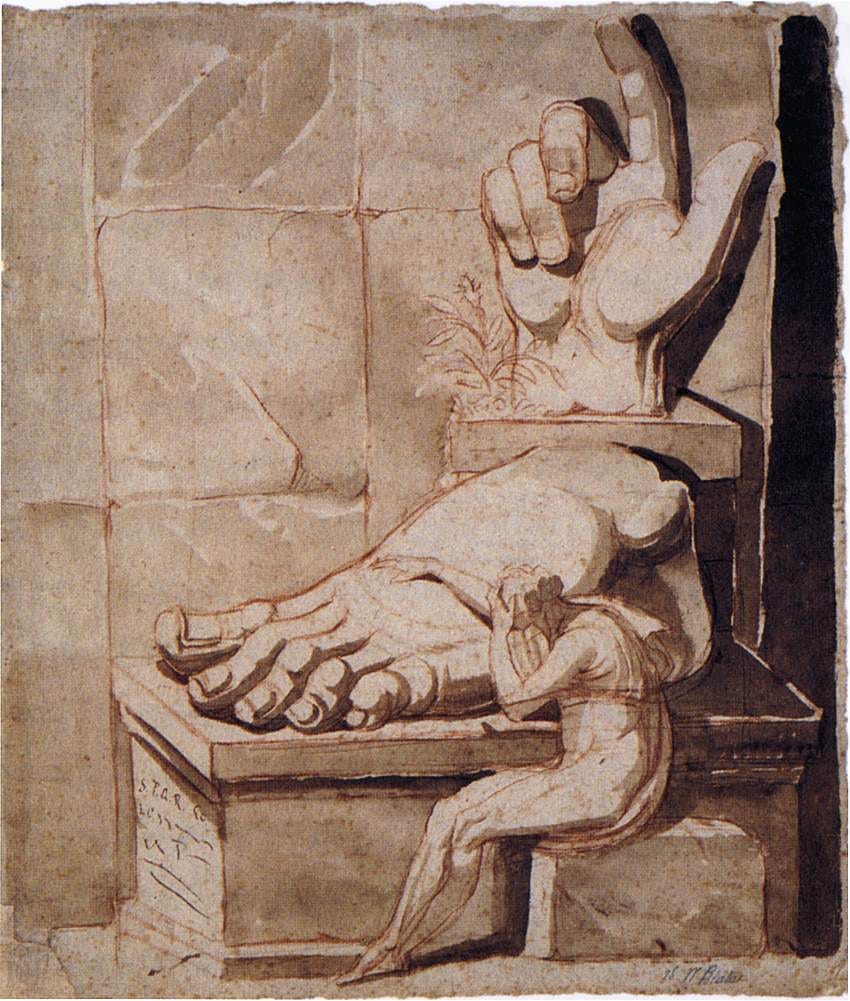
The hits keep coming. On Monday, I wrote about how the right increasingly justified itself using paleoconservative rhetorical forms—tropes of national decline, decadence, and intra-civilizational struggle—even if it did not entirely adopt the paleo policy program. On Wednesday, we got Exhibit D in Marco Rubio’s speech at the Pnyx, the birthplace of Athenian democracy.
With a dramatic view of the Parthenon in the background, Rubio delivered 25 minutes of pure kitsch. It was the classics as learned through memes by a groyped-up staffer; someone who wouldn’t know what a Doric column was if it fell on their head, but whose notions of the Greeks come from clips of Zack Snyder’s 300. It represents the reduction of the cultural patrimony of Western civilization to grindset motivational quotes. It completely stripped the Greeks—the people who gave us the words “critic,” “dialectic,” and “tragedy”—of anything fraught, contradictory, or tragic.
He starts his litany of classical examples in the worst possible place with Socrates: “We see this in Socrates, who refused to abandon the inquiry into truth even at the cost of his own life.” Of course, Socrates was put to death for the very doubt and questioning of one’s own society that Rubio condemns as a shameful loss of civilizational self-confidence. What Rubio seems to regard as a symptom of Western decadence was one of the highest achievements of Western civilization. Then he misses the entire point of the Iliad, “…Achilles, who is offered the choice to return home and live a long and peaceful life – but chooses instead to remain at Troy and perish in pursuit of eternal glory.” The first word of the epic is “rage,” and the poem is about how Achilles’s wounded honor brings destruction to his friends and countrymen.
Then Rubio invokes the word thumos, which he defines as “the fire of passion, strength, courage, pride,” and identifies as the animating force of Western civilization.1 But in Book IV of Plato’s Republic, thumos, the spirited part of the soul, must be governed by reason. Plato turns to Homer to make the point, quoting a passage from the Odyssey in which Odysseus rebukes his own angry heart. Then, in Book VIII, Plato describes a political order governed by the love of honor, military glory, and competition: timocracy. Far from representing the pinnacle of civilization, timocracy represents the degeneration of the ideal republic. What Rubio offers as a cure for Western decadence, Plato describes as the beginning of political decline. And so it is. The principle of decline of our American civilization.
Plato’s Republic contains a further irony—another one of those subtle Greek virtues that the Romanate Marcus Rubius evidently lacks. The timocracy degenerates into oligarchy, the rule of wealth. As Plato puts it, the love of honor gives way to the love of money, until men come to “commend and admire the rich man and put him in office.” What could be a more fitting description of the political situation in which Rubio now finds himself: delivering grandiloquent speeches about honor, courage, and virtue in the service of Donald Trump, the real estate hustler whose name has become synonymous with gaudy wealth.
One Greek word is conspicuously absent from Rubius’s Oration at Pnyx: hubris. We know it as overconfidence and pride, but the Greeks understood it to be the vice of arrogantly humiliating others and exercising domination for the sake of superiority it brings. As Aristotle writes in the Rhetoric:
And the man who is arrogant belittles his victim. For arrogance is doing and saying things which bring shame to the victim, not in order that something may come out of it for the doer other than the mere fact it happened, but so that he may get pleasure. […] The cause of the pleasure enjoyed by those who are arrogant is that they think that in doing ill they are themselves very much superior. That is why the young and the wealthy are arrogant. For they think that in being arrogant they are superior.
At one point, Rubio is simply wrong. He says, “The most commonly cited author in the Federalist Papers was Plutarch.” In fact, the most commonly cited author in the Federalist Papers is actually Montesquieu, but that would bring up uncomfortable questions about the separation of powers and tyranny, of course. Montesquieu identified every regime with an animating principle, a passion that sets it in motion. The principle of a republic was virtue, of monarchy, honor, and that of despotism, fear. If we were to add Trumpism to this taxonomy, its animating principle might well be hubris: not merely arrogance or overweening pride, but, in Aristotle’s original sense, the pleasure of humiliating others simply to demonstrate one’s superiority. It is not enough to defeat an adversary; he must be made to grovel. Power must prove itself through degradation.
Rubio has personal experience of such degradation: to become Secretary of State, he had to endure being “Little Marco.” He, with his fellow neocons, is the colonized power; he speaks the language of their nationalist colonizer. So perhaps Rubio’s speech really does tell us something about civilizational decline and decadence, just not the kind he intended. The neoconservatives have suffered their own strange defeat and loss of self-confidence. In an April 2012 speech at the Brookings Institution, Rubio celebrated the international institutions established under American leadership, whose purpose was “to spread peace and prosperity,” rather than merely advance narrow national interests. By January 2025, at his confirmation hearing, he was denouncing the dream of humanity becoming “one human family” as a “dangerous delusion,” declaring that the postwar global order had become “a weapon being used against us.” In February 2026, he proclaimed that the West was bound together by “Christian faith, culture, heritage, language, ancestry,” and that “armies do not fight for abstractions.” In Athens, he lamented that “the word ‘nationalism’ became a dirty word.” Yet Rubio has hardly abandoned his old commitments to American military primacy, intervention abroad, or support for Israel. The neoconservatives have tried to retain as much of their foreign policy as they can while adopting the “civilizational” nationalism of their former opponents.
If I may be permitted a classical reference of my own, which comes from Tacitus’s account of the Roman conquest of the Britons and the Britons’ subsequent adoption of Roman custom: “Idque apud imperitos humanitas vocabatur, cum pars servitutis esset. — All this in their ignorance, they called civilization, when it was but a part of their servitude.”
One suspects Rubio’s acquaintance with thumos comes not from Plato, or even from Francis Fukuyama’s The End of History and the Last Man, but from a gloss on Fukuyama. For Fukuyama, megalothymia, the desire to be recognized as superior to others, was both a source of human greatness and a potential threat to liberal democracy. Rubio seems to have retained the appetite for superiority while dispensing with the problem.
There is an old cliche about patriotism and nationalism being different things. It's gone a bit out of style these days, but I think it ought to be revived, because it is an important point. I know no better summary of the issue than that of Orwell from his Notes on Nationalism:
"By ‘nationalism’ I mean first of all the habit of assuming that human beings can be classified like insects and that whole blocks of millions or tens of millions of people can be confidently labelled ‘good’ or ‘bad’. But secondly—and this is much more important—I mean the habit of identifying oneself with a single nation or other unit, placing it beyond good and evil and recognising no other duty than that of advancing its interests. Nationalism is not to be confused with patriotism. Both words are normally used in so vague a way that any definition is liable to be challenged, but one must draw a distinction between them, since two different and even opposing ideas are involved. By ‘patriotism’ I mean devotion to a particular place and a particular way of life, which one believes to be the best in the world but has no wish to force on other people. Patriotism is of its nature defensive, both militarily and culturally. Nationalism, on the other hand, is inseparable from the desire for power. The abiding purpose of every nationalist is to secure more power and more prestige, not for himself but for the nation or other unit in which he has chosen to sink his own individuality."
Nationalists may be patriotic, even jingoistically or chauvinistically ultra-patriotic, and yet a patriot need not be a nationalist. There are also many nationalists who hate their country and most of the people who live in it.
I think the ultimate distinction is that to be patriotic involves loving a place. Patriotism can be love of one's city, or region, or country. It can be made exclusionary, but can also be cast in a broad and inclusive fashion that draws different groups together in a shared sense of civic duty. Nationalism, on the other hand, I think derives ultimately from tribalism. It's not about the place in which one lives, but about the group of people with which one identifies. Particularly, it is given to framing the world as a harsh, zero-sum competition for land and resources between contending tribes which can only be resolved by force and violence.
When one listens to nationalist speeches, like Mr. Rubio's, they often complain about internationalism and globalism and about organizations like the European Union or the United Nations. These are those "dangerous delusions" of one human family. Yet what is the substance of their complaint? They believe that internationalism is a lie that other tribes are using to exploit them. They think that cooperating and working internationally just gives other tribes an advantage in the competition, at the expense of their own tribe. So quite naturally, they also think their tribe should respond in kind.
This is the fallacy of selfishness in action. They believe that to maximise their own self-interest, they must maximise their selfish behaviours. But when all parties maximise their selfish behaviours, ultimately this harms everyone's self-interest through increasing conflict. What is actually in your self-interest, and that of your tribe or your country, is to build cooperation, which is founded on trust, which requires the wisdom to refrain from short-sighted selfish behaviour. Unrestrained selfishness just leads to fights between selfish individuals.
So too with nationalists. Because if they achieved all their desires, if they dismantled globalism and internationalism and broke up all the organizations like the EU and the UN and so on, and "restored" a world entirely of sovereign nation-states and hard borders ruled by dedicated nationalists in every country, what would be the inevitable result? The nationalists would immediately start fighting among themselves, nation against nation, and the strong preying upon the weak as in the old nationalist wars of the 19th and 20th centuries in Europe.
I despise Trumpism and all 21st century fascisms for many reasons: To a Canadian, it threatens my country. To a thinking person, it is brutish stupidity. To a person who tries to be moral, it delights in cruelty. But among all those other reasons, there is this: Its aspirations, its beliefs, its "moral" (or immoral) framework of understanding the world, all act to promote bloodshed and war.
Someone may simply have told Rubio, third-hand, about Harvey Mansfield's treatment of _thumos_.